Showing posts with label SHU PEI-PEI. Show all posts

Saturday, June 18, 2016

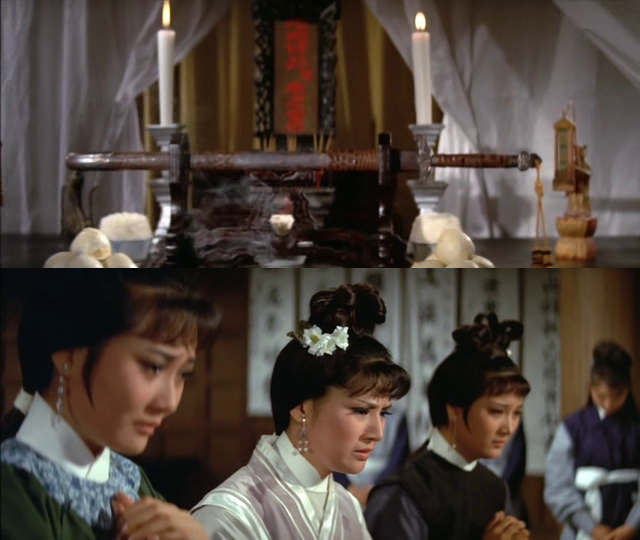
THE SECRET OF THE DIRK (1970) #054

THE SECRET OF THE DIRK (1970)


Runme Shaw produces Hsu Tseng-Hung's last directed movie for Shaw Brothers Studios: THE SECRET OF THE DIRK (1970). Hsu Tseng-Hung is the most famous director you do not know: he directed the very first movie in the wuxia genre, the wonderful BUT underrated classic, Temple of the Red Lotus (1965) [as well as the two sequels: The Twin Swords (1965) and The Sword and the Lute (1967)]. THE SECRET OF THE DIRK (1970) was released on October 24th, Yat Fong is the script writer and Tang Chia does the fight choreography all by his lonesome. The movie is told in an complex manner but it is really a simple two-party treasure hunt. Let's get busy!


A large army of robbers lead by one, Pa Tien Wang laid siege to the City of Liu for three months forcing its citizens to flee but not before pooling their most precious valuables together in single lock-box. The Liu City treasure's location was kept secret and try as they might neither the robbers nor Pa Tien Wang was able to get their hands on the treasure. 


Twenty years later, Madame Liu returns to the village where a group of the former citizens of Liu City have hidden out. She is mortally wounded by members of The Black Tiger Gang. The Black Tiger Gang are a band of notorious robbers that have learned about the Liu City Treasure Lock-Box and wants it for themselves. Madame Liu had been out searching for some of the missing citizens of Liu City especially a female child named Liu Ching Ching who is the rightful heir of the City of Liu and true custodian of the treasure. Madame Liu had gotten a lead on the child's whereabouts when she was ambushed. On her deathbed, Madame Liu assigns her four students the task of finding the heir Liu Ching Ching and restoring the treasure to the survivors of Liu City. 


Meanwhile The Black Tiger Gang locate and kidnap Liu Ching Ching with the hopes of discovering the location of the Liu Treasure but are coincidentally discovered by Da Law School senior member Zhou Ying Long, who is the sole wielder of the deadly Da Law Sword. Zhou Ying Long is a true knight errant of China and rescues Liu Ching Ching and takes the responsibility to escort her home. 


On the way to bringing Liu Ching Ching back to her home, Zhou Ying Long and Ching Ching both pass by Madame Liu's four students' camp and the students overhear Liu Ching Ching identify herself. Madame Liu's four students decide to acquire Liu Ching Ching but without her permission. By doing so, they become in direct competition with The Black Tiger Gang but with Zhou Ying Long and the Da Law School sitting smack in the middle of the conflict for the Liu City Treasure. The story continues with twists and turns and red herrings but only at the very end do we learn THE SECRET OF THE DIRK. 


Liu Chai-Yung, David Chiang, and Wang Chung starting second from left going left
CAST REPORT
the good: Ching Li as Ming Chu. Chang Yi as Zhou Ying Long. Shu Pei-Pei as Liu Ching Ching. Lin Jing as Madame Liu. Helen Ma Hoi-Lun as Xiao Lan. Cliff Lok as Xiao Ying. Fang Mian as General Liu Tsing. 
the bad: Tien Feng as Wang Shan Hu. Chiu Hung as Wan Tai Zhi.


HONORABLE MENTION: Tang Chia, Chen Kuan-Tai, David Chiang, Liu Chia-Yung and Wang Chung all have minor roles as members of the Black Tiger Gang. 


FIGHT TIME: THE SECRET OF THE DIRK (1970) was fight choreographed solo by Tang Chia. I counted eight (8) fight scenes, most of them were very short but exciting. Some of them seemed pretty chaotic but they were few in number. The movie's finale was excellent, even though it stopped just a little sudden for me there was plenty of tension and excitement as the fights went back and forth from one on one to one versus many from Ching Li's fights to Chang Yi's fights and some shots showing both at the same time. Kudos!

HONORABLE MENTION: There were two honorable mentions, one was the Da Law Sword, a fantastic weapon and the other was Ching Li's performance in the finale when she took a double-handed grip on the sword and went to town you just knew it was about to get bloody!


RECOMMENDATION
Based on the small roles of some prominent stars of the time, I am going to conclude that this is one of the many films that sat a while on a shelf a minute before being released, which in and of itself is not at all a rare practice. Nevertheless, THE SECRET OF THE DIRK (1970) is an entertaining film, flaws and all so I am going to recommend it for general viewers but not necessarily a must have for collectors. The plot twists and red herrings will make you want to watch it a couple of times to figure out what you (or they) missed. Have fun with it! See you next time!


If you liked this review please comment on the blog, become a follower of the blog, join me on my Facebook account by sending me a message first and then a friend request so I know who I am friending (  https://www.facebook.com/Michael529P   ) and like my Facebook page: SHAW Brothers Kung Fu Movies 1965-1986. I thank you and would appreciate it very much!


NEXT UP: THE IRON BUDDHA (1970)


Saturday, June 4, 2016

A TASTE OF COLD STEEL (1970) #052

A TASTE OF COLD STEEL (1970)


Sir Run Run Shaw produces another film by the team of Director Griffin Yueh Fung and Writer Wang Po I entitled A TASTE OF COLD STEEL (1970). Released September 16th, it seems to borrow a few things from August 5th's Swordswomen Three (1970) while being just marginally a sequel to the team's previous movie Rape Of The Sword (1967) made three years previous to this one. A TASTE OF COLD STEEL (1970) has a more straight forward sword stealing, character driven plot and an updated style to entertain us. The action choreography is done by Simon Chui Yee-Ang which I will get to later on, so --Let's Get Busy!


But before we get busy, I cannot allow the moment to pass before mentioning there are some similarities between these two movies released some weeks apart from each other. That said, the sheer number of times this has happened, even in Hollywood, means that I just get to mention it but not make too much of a fuss about it. It happens, trust me. Now, on with the show!


Lord Wu Yi and his step son Prince Lu Tianxia (although in the previous movie the titles are reversed) have conspired to murder Lord Gan Xiong of Fort Gan in order to acquire the Gan Family treasure The Purple Light Sword. While the surviving three daughters of Gan Xiong are still in mourning, Prince Lu Tianxia goes to Fort Gan to pay his respects but then demands the Gan Family "present the sword to the emperor" or risk having the rest of the remaining family being killed. Just as things are getting tense their cousin Hsu Chiu arrives. He had already been on his way to pay his respects but hung back seeing Lu Tianxia and Lu's men and wanting to know what Lu's plan was. A battle ensues and Prince Lu Tianxia is defeated but escapes and goes on the run. 


Exhausted and bloodied Prince Lu Tianxia stumbles into an old run down temple in which to rest and unwittingly disturbs the occupants resting within. The Five Tigers decide to beat him up for the offense and because he looks as though he has nothing of value, to kill him. Prince Lu quickly uses his wits to recruit this gang of misfit outlaws to do his bidding and go after the Purple Light Swords, jewels and the three Gan daughters. However the old adage proves true that there is no honor amongst thieves and the Five Tigers and Prince Lu Tianxia form an uneasy alliance with each waiting for the opportunity to get one-up of the other.  


The entire cast did a good job but the villains were freaking outstanding! The Five Tigers were genuinely scary and kept the tension up until the end of the movie. I know the movie is over thirty years old but I really hate to ruin the surprise guest star that comes in near the end of the movie so I won't! If you want to know who it is you'll just have to find a way to see the movie but I'm not kidding you. It is worth it if, like me, this the first time you are watching these Shaw Brothers gems from the 60's. Watching these movies in order and not just jumping to the ones I thought would be good proved to be a learning experience for me. I am very glad I did it that way. 


CAST REPORT
the good: Yau Ching (the eldest Gan sister), Essie Lin Chia  second Gan sister or Gan Ya Nan --the only sister whose name is mentioned Shu Pei-Pei (third Gan sister), and Chang Yi (cousin Hsu Chu).

the bad: Chen Hung-Lieh returning as Prince Lu Tianxia and Lee Wan-Chung returning as Lord Wu Yi. Huang Chung-Hsin was Tiger Boss number one,Ku Feng was Tiger number two, Simon Chui Yee-Ang was Tiger number three, Hung Lau was Tiger number four and Wu Ma was Tiger number five. 

HONORABLE MENTION: Wong Yap, Tian Jun, Lee Kwan, Hung Lau, and Fong Mien.


FIGHT TIME: Yes, this is the reason I watch these movies! Glad to see that this time there is an action director: Simon Chui Yee-Ang, the actor playing Tiger number three Crippled Tiger. The improvement in the fights scenes from the previous movie are quite noticeable. The women also stood out in their fights and they look like they really took their performance to heart, bravo! I counted eight (8) fight scenes and lots of action in this movie so I had a really good time watching it. No, the techniques are no where near where they will be in just a few short years but I still enjoyed the movie and respect the effort put into the production. My only sore point is the shaky-cam work. It just made it more difficult for me to see what I was looking at and I just don't care for it. 


Lee Kwan

Sammo Hung second from right

James Tien
RECOMMENDATION:

For sequels I look to see if the characters are advanced in their depiction or is the purpose of the plot moved forward. In this case neither is true. We have a very entertaining movie but it is a sequel only because the villains are again used here but they are no more this or that for this story than the last one. Yet, the new villains are better enacted in this sequel and the fights are improved and the movie stands alone in its presentation so you don't need to see the previous movie to enjoy this one. That said, it is an easy nod for me to recommend this movie (as I did the previous one) on the strength of its entertainment value alone, especially if you like creepy villains and surprise guest stars. Maybe not a collectible so much. Thanks for reading, see you next time! 


If you liked this review please comment on the blog, become a follower of the blog, join me on my Facebook account by sending me a message first and then a friend request so I know who I am friending (  https://www.facebook.com/Michael529P   ) and like my Facebook page: SHAW Brothers Kung Fu Movies 1965-1986. I thank you and would appreciate it very much!


NEXT UP: VALLEY OF THE FANGS (1970)


Saturday, April 30, 2016

THE GOLDEN KNIGHT (1970) #047

THE GOLDEN KNIGHT (1970)


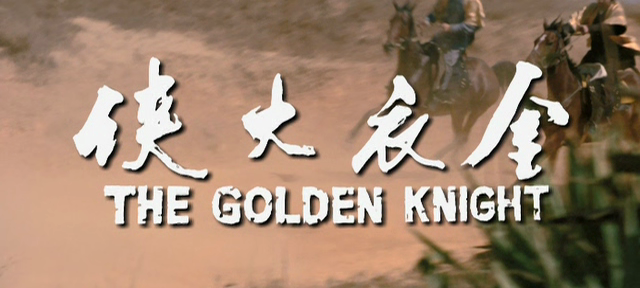
Producer Runme Shaw gives us THE GOLDEN KNIGHT (1970) a wuxia, suspenseful who-done-it with an complex script by Liang Yen (Yip Yat-Fong) [Black Butterfly 1968)] and [The Jade Raksha (1968)] co-written by Huang Feng (Wong Fung). It released April 17th and was directed by Yueh Feng [Rape of the Sword (1967)] and [The Bells of Death (1968)] with action direction by Han Kuo.  (A word about the title: in Chinese there is no such convention as adding an "s" to indicate plural nouns so the title in English could have been translated: THE GOLDEN KNIGHTS and as such would have been much more accurate considering the events of the movie. )


It is a solemn day for the Jiang Hu. The Supreme Grand Master, having been very ill and recognizing his time on earth is nearing an end, has written manuals of his six martial skills to give to six of the major heads of the martial clans. The Poison Palm, the Zen Finger, the Azura Sword, the Deadly Sabre, the Jingang Palm and the Iron Body manuals are all ready to be given to the grand masters of the six major clans on the appointed day at the appointed hour.  


On the appointed day at the appointed hour however only five of the six grand masters had arrived. Grand Master Yu Yun-Yang of Huang Shan Clan had not yet arrived so the Supreme Grand Master reserved the Poison Palm manual for Grand Master Yu Yun-Yang since it was the Huang Shan Clan's specialty and gave the remaining five manuals to the attending five grand masters and bid them to return to their clans. 


On their way back to their clans the five grand masters ran into Grand Master Yu Yun-Yang on his way to their meeting with the Supreme Grand Master and told him of the Supreme Grand Master's intention. The five grand masters then continued on their way back to their clans and Grand Master Yu continued on to see the Supreme Grand Master. But when Grand Master Yu arrived at the Supreme Grand Master's home he found the Supreme Grand Master and his servant had been murdered. Grand Master Yu immediately called out to the five grand masters to return to the Supreme Grand Master's house. 


Hearing Grand Master Yu's cries, the five grand masters ran back to the Supreme Grand Master's house as quickly as they could. When they arrived back at the Supreme Grand Master's house, they found the Supreme Grand Master and his servant dead and Grand Master Yu's bloodied belonging but not Grand Master Yu's body. The five grand masters assumed that Grand Master Yu had been murdered and carried off and could do nothing else but return to their clans and report their experience to The Tongxin Clan, Golden Knights, the clan of justice in the Jiang Hu. 


The Tongxin Clan Golden Knights are the court of justice for the Jiang Hu and all matters of law are brought before them. Shortly after the murder and disappearance of the Supreme Grand Master and Grand Master Yu, the Iron Body Manual was stolen from the Huashan Clan and the Deadly Sabre manual was stolen from the Kongdong Clan with members of both clans being killed in the process. There were two attempts made on the Zen Finger manual at Shaolin Temple but they were both unsuccessful, no one was killed and the manual was not stolen. Circumstantial evidence points to the daughter of the missing, Grand Master Yu Yun-Yang, Yu Fei-Xia --but did she commit these crimes of murder and theft, or did someone else? 


CAST REPORT
the good: Lily Ho Li-Li as Yu Fei-Xia / Jiang Yi-Ming. Kao Yuen as Lu Yi-Nan, a Golden Knight. Wang Hsieh as Master Jing Zheng-Lun, a Golden Knight.  Fan Mei-Sheng as Guan Xi-Yang, a Golden Knight. Wong Ching-Ho as Shaolin Abbot Yi-Shu. Ku Feng as Monk Tieh Teng, a Golden Knight.  Chuen Yuen as Chief of Tongxin Clan Golden Knights. 
the bad: Yeung Yip-Wang as Master Bao. Shu Pei-Pei as Ai Qing. Hsu Yu as the Censor's wife. Lan Wei-Lieh as a fake Imperial Guard.


HONORABLE MENTION: Cheng Miu and Sammo Hung Kam-Bo guest star in small roles.


FIGHT TIME: THE GOLDEN KNIGHT (1970) credits Han Kuo with the action direction of the movie but director (Griffin) Yueh Feng has too much of a heavy hand with his hand held shaky cam that readers of my past reviews know I am not a fan of. There were only six (6) fight scenes in the entire movie and they were not too bad for what I could see of them but the constant movement of the camera really robbed me of a clear view in many of those scenes and it was very annoying. That said, Han Kuo kept the movie's pace fast and exciting and I hardly noticed that there could have been another fight or two just for good measure. An acceptable performance. 


THE GOLDEN KNIGHT (1970) is a movie that, as I think about it, is probably easier to experience by Mandarin Chinese speakers than by English subtitle readers. The double flash-back one third in the movie that is actually the movie's beginning along with the lack of detail in the subtitles about just who The Golden Knights were leaves one playing catch-up quite a bit on the first viewing. If that wasn't challenging enough if the viewer has no knowledge of the Jiang Hu then the viewer really needs to watch the movie a second time before it feels like a smooth story-telling.   


If the viewer does bother to view the movie a second time and think along the lines of an episode of Law And Order Criminal Intent then they have a much better chance to discover the well crafted (but hard to translate) "who done it" scripted by Yip Yat-Fong and Wong Fung. This is one of those movies I believe would do well as a modern remake with jacked-up martial arts scenes. As it is, I can still in good conscious recommend it for ones casual viewing pleasure but as a collectible, maybe not so much. See you next time! 


If you liked this review please comment on the blog, become a follower of the blog, join me on my Facebook account by sending me a message first and then a friend request so I know who I am friending (  https://www.facebook.com/Michael529P   ) and like my Facebook page: SHAW Brothers Kung Fu Movies 1965-1986. I thank you and would appreciate it very much!


NEXT UP: HEADS FOR SALE (1970)


Saturday, December 5, 2015

THE SWORD OF SWORDS (1968)

THE SWORD OF SWORDS (1968)


Producer Runme Shaw has assembled the usual cast and crew that works with Chang Cheh including Tang Chia and Liu Chia-Liang as action directors and has replaced him with Cheng Kang to script and direct a Greek tragedy of a tale entitled THE SWORD OF SWORDS (1968). Once it gets going this wuxia tale reminds me of the biblical tale of Job. Let's jump right in and examine the plot. 


In the year 1,000 B.C. during the Sung Dynasty,  Meng Yao Chi, a master sword-smith used the best metals available and forged a sword ten years in the making. It was known as The Sword of Swords. When China was invaded by the state of Liao, Meng Yao Chi presented this sword to General Meng Liang and General Meng Liang used the sword to win battle after battle defending China, gaming fame for the sword. After General Meng's death The Sword of Sword was lost for a time until it was rediscovered during the Ming Dynasty in the possession of Master Swordsman Mui Lingchuen. The prince of a nearby barbarian tribe (during the Ming Dynasty this usually meant Mongolian) coveted the sword and dispatched a entrusted warrior, Shang Guangwu to acquire it. 


Shang Guangwu is dispatched to acquire The Sword of Swords from Master Mui. Shang Guangwu is persuaded by Fang Shishiung to conspire to decieve Master Mui rather than try to take the sword by force. They are successful in that Master Mui takes Fang Shishiung as his first student but Master Mui starts a formal school and has several students. Of all the students in the school the only concern for Fang Shishiung is his Fifth Brother: Lin Jenshiau. Although Lin Jenshiau is a meek and reserved character Fang Shishiung is rightly concerned because Lin Jenshiau has superior skills to Fang. And now, Master Mui has decided to buck tradition and give The Sword of Swords not to the most senior student but to the winner of the school tournament as the best fighter. 


Not wanting The Sword of Swords, Lin Jenshiau tries to throw his match with Fang Shishiung but Master Mui sees through this ruse and insist they fight again but Fang says no need, he will concede defeat and give The Sword of Swords to Lin Jenshiau BUT this is a ruse as well and once the sword is in his hands he gloats that he is the better man and has won. Lin fights with Fang again to protect Master Mui and The Sword of Swords breaks! It is a fake. Master Mui has foreseen through this ruse as well and commands Lin to kill Fang but Lin lets him run off. Master Mui lectures Lin and tells him that although he has let Fang go, Fang will never let go of his attempt to acquire The Sword of Swords and then, the film get serious. The sh*t that Fang and Shang Guangwu (remember him, Fang's boss?) put Lin through to try to acquire The Sword of Sword is really what this movie is all about and is enough to put anyone into therapy. 


Huang Chung-Hsin plays Shang Guangwu as a depraved, evil, lackey-in-charge who doesn't think it unless you tell him to, dispatched by a barbarian prince to acquire (read steal) The Sword of Swords. The Late Tien Feng masterfully plays Fang Shishiung as an ice-cold, twisted villian who as a child must have pulled wings off of butterflies just to watch them try to fly and is the real mastermind of the hell planned for anyone who stands between him and The Sword of Swords. 


Cheng Miu plays Master Swordsman Mui Lingchuen owner of the sword, who has to keep it from falling into the wrong hands. Jimmy Wang Yu is Lin Jenshiau, the hero, that for me, personally, I hate with a passion! The do-everything-to-me-and-my family until even Mother Teresa would have had your head on a stick- Hero that could have ended this sh*t long ago with one proper swing of the sword --but that's just me. There are Shaw Brother loyalists that I have heard love this film, ("it's a classic") and honestly I don't hate it, either, there are just a few plot holes that, the more you love Shaw Brothers the more you can over look the flaws.
HONORABLE MENTION: Li Ching as Jenshiau's wife Bai Feng for putting up with what could have been much worse.


FIGHT TIME: The team of Tang Chia and Liu Chia-Liang are the fight choreographers for THE SWORD OF SWORDS (1968). I counted 5 (five) fight scenes in the movie including the totally worth the whole movie finale that was worthy of these gentlemen getting co-plotters credits (however they don't do that in movies only in comic books). Liu Chia-Liang did a cameo as 2nd brother and a stunt double on the 720 blade attack during the inter-class tournament --sweet!


What we have here, is a successful communication. One of the fundamental rules of public writing is to never give in to using profanity. I violated this rule twice! I so disliked the character of the protagonist that I was literally yelling at the monitor like we did at the movie theater back in the days of 42nd Street. So, was this a good movie? It was a great movie quite simply because this is what a movie is supposed to do. Move you emotionally.  Kudos to Cheng Kang,  we indeed have another Shaw Brothers Classic Production that I wholeheartedly recommend to viewers and collectors alike. See you next time!


NEXT UP : DEATH VALLEY (1968)