Showing posts with label CHUEN YUEN. Show all posts

Thursday, October 13, 2016

THE DUEL (1971) #64

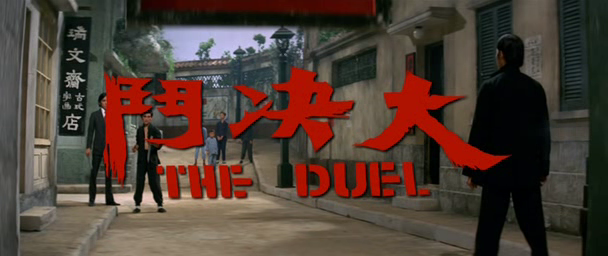
THE DUEL (1971)


Released on April 21st, THE DUEL (1971) is yet another well-loved movie produced by the elder brother Shaw: Runme Shaw. It is written by, surprise, surprise Chiu Kang-Chien, the writer of THE SINGING KILLER (1970) but not so surprisingly, also the writer of THE BELLS OF DEATH (1968). THE DUEL (1971) is a tale of intrigue set on the backdrop of the birth of The Republic of China. The great Chang Cheh is the director working once again with the action direction team of Yuen Cheung-Yan and Tang Chia putting in their most exciting work to date! Let’s get busy!


Ti Lung as Tang Ren Jia

David Chiang as Jian Nan, the Rambler  and  Cheng Kang-Yeh as Xiao Mao

On the surface of it THE DUEL (1971) is a tale of a fateful duel between two fighters. Tang Ren Jie is fighting to avenge his godfather’s death at the hands of a journeyman in the underworld (the Rambler), Jian Nan, a highly skilled fight with no ties to any one gang and as such can be persuaded to help one gang or another. In this case however, Jian Nan is deceived in killing Tang Ren Jie’s godfather, Shen Tian Hung, an elder gang boss who is actually retiring from the criminal life after taking revenge for a friend of his who was also killed recently. Jian Nan must fight Tang Ren Jie but he is sorrowful for what he feels is an unworthy kill for him since his victim was going to retire from the gang life and become a civilian. 
Tang Ren Jie saves Jian Nan's life during a battle
THE DUEL (1971) takes place during “The Warlord Era” or the period after the Qing Dynasty from 1916 to 1927. Whether they were called warlords or bandits or gangsters, these people wrecked havoc on life in Mainland China where it was a “man’s world” and if you were weak or a woman you could be forced to do whatever you were told and corruption was everywhere and justice was whatever the powerful said it was. I mention this because the more you know of China and this era the more there is for you to experience in THE DUEL (1971), it is that deep.  There are double crosses galore and everybody has deep characterization if you care to look for it. A look at life in China after the Qing Imperial government and before Communist Party rule, THE DUEL (1971) is a must have for everyone's library of Asian films.   


Chuen Yuen steals this scene but ONLY if you are paying attention to details

CAST REPORT
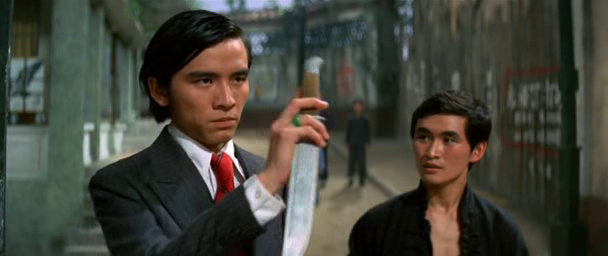
the “good”:  Ti Lung as Tang Ren Jie. David Chiang as Jian Nan, the Rambler. Chang Kang-Yeh as Xiao Mao. Ku Feng as Tang Jen Lin. Wang Ping as Hu Die.
the bad: Chuen Yuen as Gan Wei Bin. Hung Lau as Shiu Li. Wang Ching Ho as Jau Hai Shan. Lee Wan-Chung as Senator Fung.


HONORABLE MENTION: Chuen Yuen is absolutely repulsive as the big bad, excellent acting especially when you are not suppose to focused on him. 


FIGHT TIME: THE DUEL (1971) was choreographed by the fight team of Tang Chia and Yuen Cheung-Yan. Their design style could certainly be called “fast and furious” and it was again difficult for me to grab screen shots of action without any blur. They also like to keep multiple fights working simultaneously making for some very exciting scenes where you could get caught up in just trying to follow everything. I counted twelve (12) fight scenes making this one of the most fight filled movies to date. No wonder this one is a fan favorite!
HONORABLE MENTION: The all-star cast of henchmen used throughout the film. Including: Liu Chia-Yung, Yuen Woo Ping, Fung Hak-On, Cliff Lok, Wang Chung, Yuen Shun-Yi, Chen Kuan-Tai, Bruce Tong Yim-Chaan, and more!


RECOMMENDATION: Any Shaw Brothers, David Chiang and Ti Lung co-starring project needs no one's recommendation, especially mine. It is entertaining and collectible. It is automatically a must-see and a must-have. See you next time!


If you liked this review please comment on the blog, become a follower of the blog, join me on my Facebook account by sending me a message first and then a friend request so I know who I am friending (  https://www.facebook.com/Michael529P   ) and like my Facebook page: SHAW Brothers Kung Fu Movies 1965-1986. I thank you and would appreciate it very much!


NEXT UP: THE EUNUCH (1971)


Saturday, May 14, 2016

VENGEANCE! (1970) #049

VENGEANCE! (1970)


Chang Cheh is back and he is once again turning the new wuxia genre on its head with his creativity. Producer Runme Shaw presents VENGEANCE! (1970), released on May 14th it was directed by Chang Cheh, written by Chang Cheh and frequent co-writer I Kuang. The action is directed by Tang Chia and Yuen Cheung-Yan, two of the best in the business working together once again. Let's get busy!


Guan Xiao Lou is a man on fire as he sets out to kill everyone involved with the murder of his older brother over their desire for his older brother's unfaithful wife. 


CAST REPORT
the good: Ti Lung as Guan Yu Lou. David Chiang as Guan Xiao Lou. Wang Ping as Hua Zheng Fang. 
the bad: Alice Au Yin-Ching as Hua Zheng Fen. Ku Feng as Feng Kai Shan. Yeung Chi-Hing as Jin Zhi Quan. Chuen Yuen as Adjutant Gao Hong Tu. Hoh Ban as Generalissimo Hu Hu Cheng. Wong Ching-Ho as Yin Nan Ting. Chen Sing as Li Qi.


HONORABLE MENTION: This is Chen Kuan-Tai first appearance in a Shaw Brothers movie. Wang Kuang-Yu, Cheng Lui, Wang Chung, Cliff Lok, Yuen Woo-Ping, and Jason Pai Piao also have small roles as henchmen.


CHEN KUAN-TAI

WANG KUANG-YU
CHENG LUI


WANG CHUNG

CHEN SING


FIGHT TIME: VENGEANCE (1970) starts a new sub-genre in the category of wuxia films: namely modern kung fu. The movie takes place in the twentieth century, so the weapons and techniques used are more up to date than those wuxia tales of the dynasties of ancient China. Tang Chia and Yuen Cheung-Yan do the action direction that mostly involve hatchets, small throwing knives and huge bowie like knives. I counted four (4) fight scenes but there is still plenty of action throughout the movie. Excellent work!

HONORABLE MENTION: Ti Lung's athleticism in his youth is showcased in his opera performance, don't miss this! 


Chang Cheh has done it again! VENGEANCE (1970) is another Shaw Brothers classic movie that is truly deserving of the designation "classic". There are so many firsts and guest stars and cameos of future stars in this movie it is an instant collectors item. As far as the movie watching experience, it is a rather grim but entertaining and thought provoking showcase that no one should miss! See you next time!


If you liked this review please comment on the blog, become a follower of the blog, join me on my Facebook account by sending me a message first and then a friend request so I know who I am friending (  https://www.facebook.com/Michael529P   ) and like my Facebook page: SHAW Brothers Kung Fu Movies 1965-1986. I thank you and would appreciate it very much!


Saturday, April 30, 2016

THE GOLDEN KNIGHT (1970) #047

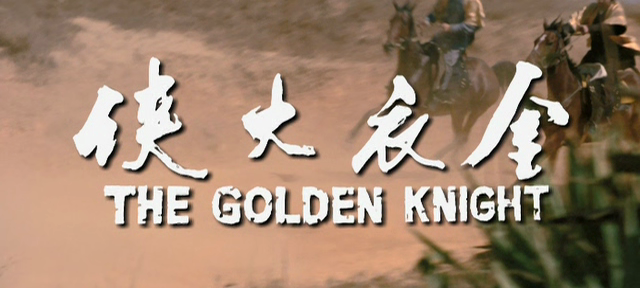
THE GOLDEN KNIGHT (1970)


Producer Runme Shaw gives us THE GOLDEN KNIGHT (1970) a wuxia, suspenseful who-done-it with an complex script by Liang Yen (Yip Yat-Fong) [Black Butterfly 1968)] and [The Jade Raksha (1968)] co-written by Huang Feng (Wong Fung). It released April 17th and was directed by Yueh Feng [Rape of the Sword (1967)] and [The Bells of Death (1968)] with action direction by Han Kuo.  (A word about the title: in Chinese there is no such convention as adding an "s" to indicate plural nouns so the title in English could have been translated: THE GOLDEN KNIGHTS and as such would have been much more accurate considering the events of the movie. )


It is a solemn day for the Jiang Hu. The Supreme Grand Master, having been very ill and recognizing his time on earth is nearing an end, has written manuals of his six martial skills to give to six of the major heads of the martial clans. The Poison Palm, the Zen Finger, the Azura Sword, the Deadly Sabre, the Jingang Palm and the Iron Body manuals are all ready to be given to the grand masters of the six major clans on the appointed day at the appointed hour.  


On the appointed day at the appointed hour however only five of the six grand masters had arrived. Grand Master Yu Yun-Yang of Huang Shan Clan had not yet arrived so the Supreme Grand Master reserved the Poison Palm manual for Grand Master Yu Yun-Yang since it was the Huang Shan Clan's specialty and gave the remaining five manuals to the attending five grand masters and bid them to return to their clans. 


On their way back to their clans the five grand masters ran into Grand Master Yu Yun-Yang on his way to their meeting with the Supreme Grand Master and told him of the Supreme Grand Master's intention. The five grand masters then continued on their way back to their clans and Grand Master Yu continued on to see the Supreme Grand Master. But when Grand Master Yu arrived at the Supreme Grand Master's home he found the Supreme Grand Master and his servant had been murdered. Grand Master Yu immediately called out to the five grand masters to return to the Supreme Grand Master's house. 


Hearing Grand Master Yu's cries, the five grand masters ran back to the Supreme Grand Master's house as quickly as they could. When they arrived back at the Supreme Grand Master's house, they found the Supreme Grand Master and his servant dead and Grand Master Yu's bloodied belonging but not Grand Master Yu's body. The five grand masters assumed that Grand Master Yu had been murdered and carried off and could do nothing else but return to their clans and report their experience to The Tongxin Clan, Golden Knights, the clan of justice in the Jiang Hu. 


The Tongxin Clan Golden Knights are the court of justice for the Jiang Hu and all matters of law are brought before them. Shortly after the murder and disappearance of the Supreme Grand Master and Grand Master Yu, the Iron Body Manual was stolen from the Huashan Clan and the Deadly Sabre manual was stolen from the Kongdong Clan with members of both clans being killed in the process. There were two attempts made on the Zen Finger manual at Shaolin Temple but they were both unsuccessful, no one was killed and the manual was not stolen. Circumstantial evidence points to the daughter of the missing, Grand Master Yu Yun-Yang, Yu Fei-Xia --but did she commit these crimes of murder and theft, or did someone else? 


CAST REPORT
the good: Lily Ho Li-Li as Yu Fei-Xia / Jiang Yi-Ming. Kao Yuen as Lu Yi-Nan, a Golden Knight. Wang Hsieh as Master Jing Zheng-Lun, a Golden Knight.  Fan Mei-Sheng as Guan Xi-Yang, a Golden Knight. Wong Ching-Ho as Shaolin Abbot Yi-Shu. Ku Feng as Monk Tieh Teng, a Golden Knight.  Chuen Yuen as Chief of Tongxin Clan Golden Knights. 
the bad: Yeung Yip-Wang as Master Bao. Shu Pei-Pei as Ai Qing. Hsu Yu as the Censor's wife. Lan Wei-Lieh as a fake Imperial Guard.


HONORABLE MENTION: Cheng Miu and Sammo Hung Kam-Bo guest star in small roles.


FIGHT TIME: THE GOLDEN KNIGHT (1970) credits Han Kuo with the action direction of the movie but director (Griffin) Yueh Feng has too much of a heavy hand with his hand held shaky cam that readers of my past reviews know I am not a fan of. There were only six (6) fight scenes in the entire movie and they were not too bad for what I could see of them but the constant movement of the camera really robbed me of a clear view in many of those scenes and it was very annoying. That said, Han Kuo kept the movie's pace fast and exciting and I hardly noticed that there could have been another fight or two just for good measure. An acceptable performance. 


THE GOLDEN KNIGHT (1970) is a movie that, as I think about it, is probably easier to experience by Mandarin Chinese speakers than by English subtitle readers. The double flash-back one third in the movie that is actually the movie's beginning along with the lack of detail in the subtitles about just who The Golden Knights were leaves one playing catch-up quite a bit on the first viewing. If that wasn't challenging enough if the viewer has no knowledge of the Jiang Hu then the viewer really needs to watch the movie a second time before it feels like a smooth story-telling.   


If the viewer does bother to view the movie a second time and think along the lines of an episode of Law And Order Criminal Intent then they have a much better chance to discover the well crafted (but hard to translate) "who done it" scripted by Yip Yat-Fong and Wong Fung. This is one of those movies I believe would do well as a modern remake with jacked-up martial arts scenes. As it is, I can still in good conscious recommend it for ones casual viewing pleasure but as a collectible, maybe not so much. See you next time! 


If you liked this review please comment on the blog, become a follower of the blog, join me on my Facebook account by sending me a message first and then a friend request so I know who I am friending (  https://www.facebook.com/Michael529P   ) and like my Facebook page: SHAW Brothers Kung Fu Movies 1965-1986. I thank you and would appreciate it very much!


NEXT UP: HEADS FOR SALE (1970)


Saturday, December 26, 2015

THE FASTEST SWORD (1968)

THE FASTEST SWORD (1968)


THE FASTEST SWORD (1968) is our last movie for 1968.  Sir Run Run Shaw produced this beauty written and directed by Pan Lei. Most reviewers say THE FASTEST SWORD (1968) is an adaptation of  THE GUNFIGHTER (1950) directed by Henry King but I found at least one reviewer that feels it is more akin to THE FASTEST GUN ALIVE (1956) directed by Russell Rouse. After watching both movies from start to finish it is clear that, in fact, both movies strongly influenced Pan Lei's script and a couple of scenes in both movies show up in THE FASTEST SWORD (1968). So there's no need to pick one over the other because it is not at all unusual for a director/writer to have multiple influences affect his work in addition to having his own ideas on how he wanted to move a project. Let's check out the plot.  


In the Jiang Hu, Ding Menghao is a very good swordsman. So good that he earned for himself the title: "Sword of the South". It wasn't long before he had earned another title for himself, the title of "Fastest Sword". He earned this title by winning duels. He won by killing his opponents in these duels without mercy.  Ding Menghao was a man who valued skills. Ding Menghao was a man that valued titles. Ding Menghao was not a man who valued human life. But Ding Menghao would meet a man who would change him and teach him to value human life but it would take some time. 


Ding Menghao wondered how long the old monk had been there watching him. He had certainly been there when the remaining three Zhongzhou Swordsmen came because he critiqued Menghao's  swordplay and was not altogether pleased with his style of killing. How did the old monk know about fighting? Did he used to be a swordsman? The old monk was certainly exceptionally skilled. Menghao did not even see him move let alone see the strike that left the impression of the old monk's pipe on the front of his garment. Because of that strike and his wager with the old monk Menghao had spent three whole years with him in the temple. 


Strange though, how the old monk didn't seem to really want anything more from him than his time. In fact, often the old monk would leave him alone for months at a time. First Menghao meditated, but was dissatisfied, so the monk suggested that Menghao transcribe scriptures, but again Menghao found dissatisfaction. The monk then suggested making something out of a huge rock and the old monk said that it didn't matter what it was but it must be something that Menghao liked. "Smaller", "smaller", the old monk said, after Menghao's first two attempts but the third sculpture seemed to satisfy the old monk and then the three years were up. The three years had passed rather painlessly. So strange... Never mind though, Menghao was free now. he could go back into the world, back to his life.


Ding Menghao returned to his village and so did the challenges for his title and the deaths. In less than three months there were at least twelve deaths. Oddly though, Ding Menghao was no longer unaffected by the killing. Why are they throwing their lives away just for a title?  If only, he could stop the killings... the rest of the movie is his journey and his fate. 

Liu Ping is Ding Menghao and is an excellent actor, especially skilled with his facial expressions and is believable as the south sword: a passionless killer. This is his movie. Liu Wai plays the old monk and is never mentioned by name. Chu Jing is Liu Qing Er, the daughter of the martial village chief. The big bad villain is played by Li Kuan-Chang as Flying Centipede, 
HONORABLE MENTION: Gao Ming does a fine job as Qiu Yixing the Northern Sword


FIGHT TIME: There is no fight choreographer credited for THE FASTEST SWORD (1968) so that lowers my expectation for the fight scenes, however, that being said, there are moments of brilliance during some of the duels that I really appreciated.  Director Pan Lei has given us a truly "Eastern, Western" in the fight choreography. I counted eight (8) action scenes with many of them short duels which yielded a interestingly paced movie. Showing a high level of martial arts skill is very difficult for martial arts experts so the director  Pan Lei is to be commended. 


THE FASTEST SWORD (1968) has laid open for us the eastern philosophies of life and death with this multi faceted script. I watched this film multiple times, which is my standard operating procedure to research the film so I may review it accurately, yet the third and fourth times I watched it I observed that even the silence (as in many Japanese films) held volumes of expression. As for the western influence, not only did it not spoil the message but punctuated that the philosophies herein were universal making for a classic film. So it should come as no surprise that I am recommending THE FASTEST SWORD (1968) to all viewers and collectors alike. See you next time!


If you liked this review please comment on the blog, become a follower of the blog, join me on my Facebook account by sending me a message first and then a friend request so I know who I am friending (  https://www.facebook.com/Michael529P   ) and like my Facebook page: SHAW Brothers Kung Fu Movies 1965-1986. I thank you and would appreciate it very much!


NEXT UP: TWIN BLADES OF DOOM (1969)