Showing posts with label HUANG CHUNG-HSIN. Show all posts

Saturday, June 25, 2016

THE IRON BUDDHA (1970) #055

THE IRON BUDDHA (1970)


WARNING!!!: The Iron Buddha (1970) contains sexually mature subject matter and is not suggested by this author for young children or squeamish adults, parental guidance is advised.

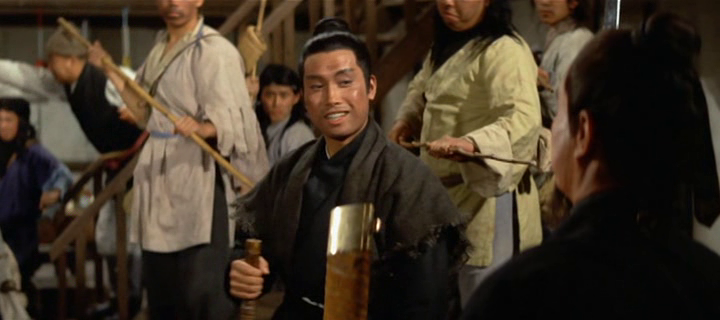
On November 12, 1970 Shaw Brothers Studios released THE IRON BUDDHA (1970) produced by Sir Run Run Shaw, directed by veteran actor, Yan Jun with the script chores done by two time script writer, Sung Hiu-Wong (as Sung Kang) and action directed by Sammo Hung (as Chu Yuan Lung) and Han Kuo. This is a very twisted but psychologically interesting revenge tale with the revenge seeker in the first half of the tale being an unrepentant serial rapist! Let's get busy!


Xiao Tianzun of the Yun Mountain Sect is on the prowl. He is a serial rapist and has just spotted his next victim in a silhouette from a home he has happened to pass. Unfortunately for Xiao Tianzun, the hero known as Wind Chasing Knife Master Liu Peng also happens to be enjoying the hospitality of the family that owns the home along with his two daughters and his senior student. The hero and his daughter stop Xiao Tianzun from raping the mute daughter of a blind woman and Xiao Tianzun quickly begins begging for his life. Master Liu's daughters and student all protest strongly, nevertheless, Master Liu grants Xiao Tianzun's request to spare his life but scars Xiao Tianzun's chest to teach him a lesson.


It is three years later and Xiao Tianzun has made some changes in his life. He has NOT however, turned over a new leaf. Instead, he has planted roots in the world of the Jiang Hu as a notorious rapist and a very evil man. He has murdered his sifu and his sifu's family. He has acquired the famous Evil Poisonous Sword and with it has joined a heretic sect. He is now lying in wait for Wind Chasing Knife Master Liu Peng and his two daughters. Xiao Tianzun left a note for Master Liu's students to come and collect their teacher's body somewhere in the woods. Xiao Tianzun intends to murder Master Liu rape his daughters and then murder all of Master Liu's students in order to punish Master Liu and the world for allowing him to live. Let's look and see how it turns out for this odd fellow, shall we? 


Luo Han is the second eldest of Master Liu Peng's students. He is nick-named The Iron Buddha. As the sole survivor of Xian Tianzun's massacre, it has become his responsibility to seek justice for his master, his clan, the people of Swallow Valley and the murdered family and owner of the Ten Mile Inn. But in order to defeat Xian Tianzun's Evil Poisonous Sword, Luo Han must first travel to the capitol and get the precious Hulong Saber. With villains to the front of him, villains to the back of him and villains to the side of him, will he succeed? 


CAST REPORT
the good: Ling Yun as Luo Han. Fang Ying as Mu Dan. Ku Wen-Chung as Uncle Chen Imperial Guard Wang Qi. Lee Sau-Kei as Master Liu Peng.
the bad: Huang Chung-Hsin as Xiao Tianzun. Chen Hung-Lieh as Master Geng Xian. Fan Mei-Sheng as Master Luo.


HONORABLE MENTION: Sammo Hung, James Tien, Liu Chia-Yung, Wang Chung and Chiu Hung have minor roles as villains. Huang Chung-Hsin gives a command performance as Xiao Tianzun the pathological serial rapist, murderer that makes the movie a must see!


FIGHT TIME (or "can you handle the truth?"): I counted eleven (11) fight scenes including the finale in THE IRON BUDDHA ()1970) which credits Sammo Hung and Han Kuo as the action directors. As far as Han Kuo goes, his entire action directing career spans a whopping total of 3 movies, period. Conversely, Sammo Hung continues to work to this day and the quality of his work is literally, legendary. As politely as I can put it: this is NOT the movie to watch for experiencing quality action direction. Some of the fight scenes are badly over-cranked often looking "cartoonish". The editing is also chaotic and aids in a negative experience with the fight scenes. "Nuff said." 
HONORABLE MENTION: none.


RECOMMENDATION
THE IRON BUDDHA (1970) is a peek at pure evil or as close as I have seen so far of pure evil in a wuxia movie. Even though Sung Kang (Hiu-Wong) never wrote another screenplay after this one I can't say why this script would be considered so bad... --okay I can, but themes of the psychological underpinnings of pathological criminals should not only be pursued by television crime drama script writers but those that want to expand and kept the wuxia genre alive. People now-a-days will be more likely to see your movie if there is more to it than "Why did you kill my teacher?" (or "steal my elephant?"). For these reasons I recommend THE IRON BUDDHA (1970) as a "must-see" especially for students of film making, but as a collectible --not so much. See you next time!


If you liked this review please comment on the blog, become a follower of the blog, join me on my Facebook account by sending me a message first and then a friend request so I know who I am friending (  https://www.facebook.com/Michael529P   ) and like my Facebook page: SHAW Brothers Kung Fu Movies 1965-1986. I thank you and would appreciate it very much!


NEXT UP: THE CHINESE BOXER (1970)


Saturday, April 16, 2016

LADY OF STEEL (1970)

LADY OF STEEL (1970)


LADY OF STEEL (1970) is a straight wuxia revenge tale released February 27th that uses the Southern Song Dynasty as its backdrop. It was produced by Runme Shaw, directed by Ho Meng-Hua with the script by Liang Jen and action direction by Leung Siu-Chung. Let's get busy!


Security Chief Fang Ning and assistant Chiu Hung are escorting one million taels of silver for refugees along the yellow river, when they stop to rest at an inn off the main road. The inn turns out to be owned by former security chief Han Shi Xiong and his assistant Wei Tong Ming, but Han Shi Xiong uses it to rob and murder escorts that know of the old route that is rarely used. Unfortunately, Chief Fang Ning has also brought along his wife and child and, in this slaughter of everyone, only his child, a daughter named Fang Ying Qi, escapes with her life. 


Priest Xuan Zhen found Fang Ying Qi just as she escaped, raised her and taught her kung fu for the past twenty years. Priest Xuan Zhen taught her it was Han Shi Xiong who was responsible for killing her family and although she is ready to take revenge, the Jin invasion of north China and the restoration of the Song Dynasty should be a priority for the heroes of the Jiang Hu and she must wait. Priest Xuan Zhen gives Fang Ying Qi a letter of recommendation to bring to Lord Xia Zi Long, the chief of the Flying Dragon Clan whose fortress is in the Da Kun Moutains, so she may join the effort to fight the foreign invaders.


Fang Ying Qi stops at an Inn along the way to Flying Dragon Fortress that, as fate would have it, is a way station for her life long enemies. She also meets the leader of the Beggar Clan: Chin Shang-Yi. Blades flash and tempers fly as the two masters of martial arts go at it. The rest, is well worth watching for yourself! 


CAST REPORT
the good: Cheng Pei-Pei as Fang Ying Qi. Yueh Hua as Qin Shang Yi. Ku Wen-Chung as Priest Xuan Zhen. Fang Mian as Lord Xia Zi Long.
the bad: Huang Chung-Hsin as Han Shi Xiong. Lee Wan-Chung as Wei Tong Ming. Lee Pang-Fei as Wu Chang Sheng.


HONORABLE MENTION: Yuen Lo (Jacky Chan), Meng Yun Man and Han Guo Cai all do stunt / extra work early in their career in this movie.  


FIGHT TIME: LADY OF STEEL (1970) is a straight forward revenge tale albeit well written with action choreographed by Leung Siu-Chung. I counted eight (8) fight scenes that were clean with easy to follow, realistic techniques. At a little over 80 minutes there is no room for boredom, nothing new here -- no doubt, but no boredom at all.


LADY OF STEEL (1970) while offering nothing new is still a solid outing by Cheng Pei-Pei and Yueh Hua who have previously worked together in the 1960's on some of Shaw Brothers great wuxia movies. I am recommending this movie for casual viewers for the entertainment value and for collectors for the appearances of future stars early in their careers. See you next time!


If you liked this review please comment on the blog, become a follower of the blog, join me on my Facebook account by sending me a message first and then a friend request so I know who I am friending (  https://www.facebook.com/Michael529P   ) and like my Facebook page: SHAW Brothers Kung Fu Movies 1965-1986. I thank you and would appreciate it very much!


NEXT UP: BROTHERS FIVE (1970)


Saturday, March 12, 2016

THE GOLDEN SWORD (1969)

THE GOLDEN SWORD (1969)


Our next movie in 1969 is also produced by Sir Run Run Shaw. Lo Wei directs and writes the script for the film adaptation of the I Kuang novel THE GOLDEN SWORD. This time Mr. Wei uses action directors Sammo Hung Kam-Bo and Simon Chui Yee-Ang. Let's get busy!  


To director Lo Wei's left is BRUCE TONG YIM CHAAN in his first appearance!

The Chief of Golden Sword Lodge, Eight Arm Dragon Bai Chun-Tun voluntarily rides away from his fortress with two masked horsemen in the middle of the night and goes missing, leaving his man at arms, Uncle Pang at the doorway apparently wondering what is going on. Bai Chun-Tun is also the chief over 36 clans in an Jiang Hu association and it searches for him for seven years before electing a new chief to replace him.  

However Bai Yu-Lung, the missing chief's son requests permission to look for his missing father for another three years because he has "a feeling" his father is still alive. His request is granted.


While out in the frontier looking for his father, Bai Yu-Lung meets Ngai Jin-Feng of the Beggar Clan. They form an instant liking of each other which becomes a bond. She becomes his companion as he searches for his father and after the three years are up they get married. 


The next morning after their wedding a mysterious box is discovered among the wedding gifts that turns out to contain The Dragon Hall Golden Sword last seen with the missing chief ten years ago. Then, two masked riders that look similar to the two riders that rode off with the missing chief show up again and using kung fu far superior than everyone present take by force Bai Yu-Lung.  

Suddenly, Uncle Pang tells everyone he knows what is going on and he directs them inside the fortress to explain to the existence of Dragon Hall Palace and the events of the past ten years. From here everything just gets, well, weird...


CAST REPORT 


THE GOLDEN SWORD (1969) does not break down in the typical good guy bad guy manner. The only logical way to classify the cast without spoiling it for those whom have yet to see it is to divide the cast into the "first half" of the movie and the "second half" of the movie. 
So, in the first half, we have Lo Wei as Eight Arm Dragon Bai Chun-Tun but he spends the first half of the movie missing. Next we have Kao Yuen as Bai Yu-Lung who spends the first half of the movie looking for his father. Cheng Pei-Pei is Ngai Jin-Feng, Yu-Lung's better half and the movie's "red herring". Yeung Chi-Hing as Golden Dragon Hall's keeper Uncle Pang. 

HONORABLE MENTION FIRST HALF:
In the first half of the movie we meet The Beggar Clan that raised Jin-Feng and The Three Cripples, of which two are Ku Feng and James Tien. Also Sammo Hung Kam-Bo does a cameo as well as Chin Yuet Sang's cameo as a martial elder that an interesting run after a horse.


Next, in the second half, we have Wang Lai as Lung Xing Zi, Kao Pao-Shu as Seventh Lady, Huang Chung-Hsin as Saintly Swordsman and Alice Au Yin-Ching as Chen Yu-Lan.

HONORABLE MENTION SECOND HALF: a great, big, huge, stone tablet. 

SAMMO HUNG far right cameo / stunt fighter
FIGHT TIME: THE GOLDEN SWORD (1969) had two action directors, namely Simon Chui Yee-Ang and Sammo Hung Kam-Bo. I counted eight (8) fight scenes in the entire movie and while some of them were quite short they were all quite good, especially the unarmed combat. These unarmed fights were above anything I have seen in all of the movies I have reviewed in the 1960's so far. I was very impressed!

HONORABLE MENTION: The unarmed fights in the second half of the movie far outshone the armed fights of the first half. 


As stated when we started the review, THE GOLDEN SWORD (1969) is an adaptation of a novel written by Ni Kuang (I Kuang's pen name) and as such inherits the difficulty of such adaptations. That said, this is hardly a straight forward tale and not being familiar with the original work has us at a disadvantage. The easy part is recommending this as a collectible work, unquestionably one should have this movie as part of any early Shaw Brothers collection. On the other hand I am compelled to recommend this movie for viewers because it is not a bad movie in and of itself but rather, I dare say, perhaps it is just told poorly under all of the above named circumstances. See you next time!


If you liked this review please comment on the blog, become a follower of the blog, join me on my Facebook account by sending me a message first and then a friend request so I know who I am friending (  https://www.facebook.com/Michael529P   ) and like my Facebook page: SHAW Brothers Kung Fu Movies 1965-1986. I thank you and would appreciate it very much!


NEXT UP:  HAVE SWORD WILL TRAVEL (1969)


Saturday, March 5, 2016

THE SWORDMATES (1969)

THE SWORDMATES (1969)


THE SWORDMATES (1969) is a short uncomplicated film that was probably intended as the second film of a double feature. Runme Shaw produced this movie that has two directors (Cheung Ying and Poon Fan) and two Script writers (Poon Fan and Chin Ko) but no action directors. Let's get busy.


There's not much work for me here as the producers have provided a plot summary for the audience on screen but, for the sake of convenience, I will reproduce it here.


"In the dawn of the 15th century during the reign of the Ming Emperor Zheng De, the ambitious King An Hua of Ning Xia province conspired with the neighboring Ai Xin Jue Luo Tribe to overthrow the reign of the Ming. The details of their scheme were hidden in a jade statue of the goddess of mercy: Guan Yin for information transmission. 

Governor Lin intercepted the statue en route and commissioned a dexterous swordmate named Yan-Niang to deliver it to the capitol. Panic stricken, the plotters use all their resources in a desperate attempt to recover the statue. It is against this background that our story is set. " 


CAST REPORT:
The good : Chin Ping as Li Yan-Niang, for sure, the star of the show, with only one other cast member seeming to be having as much fun as she was. Chung Wah as Chao Ying-Chieh, Huang Chung-Hsin as Li Fei-Lung,
The bad : Wang Hsieh as Wang Tian-Piao, Yeung Chi-Hing as Iron Claws Wang Ying, eating up the screen, having a lot of fun this time around as, once again, the great big bad guy! Chiu Hung as Second Brother, Wang Kuang-Yu as Third Brother, Law Hon as Fat Jin-Gang

HONORABLE MENTION: James Tien Chuen and Sammo Hung Kam-Bo as stuntmen / extras


FIGHT TIME: THE SWORDMATES (1969) has no action director credited but is action-packed with eight (8) fight scenes by my count. The fights are surprisingly smooth and easy to follow so one of the directors may have martial arts experience. The quality of the fights are state of the art for 1969 which leaves no reason for them to not be enjoyed.

HONORABLE MENTION: Both Chin Ping and Yeung Chi-Hing performed their techniques with the appropriate enthusiasm for maximum enjoyment. Yeah.   


For what it is, THE SWORDMATES (1969) is fine entertainment for casual viewers of Shaw Brothers and wuxia movies and may be of interest for people collecting the complete works of Sammo Hung Kam-Bo as he is used at least two different times as two different extras in this film. See you next time!


If you liked this review please comment on the blog, become a follower of the blog, join me on my Facebook account by sending me a message first and then a friend request so I know who I am friending (  https://www.facebook.com/Michael529P   ) and like my Facebook page: SHAW Brothers Kung Fu Movies 1965-1986. I thank you and would appreciate it very much!


NEXT UP: THE GOLDEN SWORD (1969)


Saturday, January 30, 2016

DRAGON SWAMP (1969)

DRAGON SWAMP (1969)


DRAGON SWAMP (1969) is Runme Shaw's production of a fascinating fantasy / wuxia tale from the fertile mind of director and script writer Lo Wei. Using the captivating canvass of the Shaw Brothers beauty Cheng Pei Pei, Lo Wei and make-up artist Fong Yuen add a wonderful dimension to what otherwise had been another "they stole my magic sword" wuxia tale. Let's take a look. 


The JADE DRAGON SWORD is a coveted treasured sword from the Shangzhou Dynasty. Unfortunately, after being used to murder an enlightened personage that was a reincarnation of the holy Buddha it became cursed. Whoever attempts to own the sword is possessed with a madness and their family is fated to be broken. The sword came to be trusted to the Taoist Lingshan Chunyang Monastery. 


Under the current abbot, Master Fan Chung Yun, the Jade Dragon Sword was stolen by Tang Dachuan the White-Faced General. Tang Dachuan seduced Master Fan's student Fan Ying, a 17-year-old impressionable young girl who betrayed everyone and everything she knew for the "love and kindness" of the sweet-talking devil. Three years and two children later (not to mention a certain Jade Dragon Sword) the two lovers hiding place is discovered by Master Fan. Tang Dachuan escapes with the older child and leaves behind Fan Ying and the younger child. Master Fan recovers the Jade Dragon Sword and punishes Fan Ying to a twenty year banishment in the Dragon Swamp but he takes the youngest child with him to raise in his monastery.  


20 years later, a grown up Qing Erh practices the 8 diagram steps at the Jingang Pagoda unaware that she is being observed but when it is discovered that the Jade Dragon Sword has once again been stolen Qing Erh suspects that she is the one responsible for the thief's ability to walk the correct steps to get the sword. She sneaks out of the monastery determined to reclaim the sword for her teacher and ask for his forgiveness. It is not the sword, however, but her face that sets up the incidents that become a fascinating adventure for the young girl and for us. 


DRAGON SWAMP (1969) has an all-star cast but Cheng Pei Pei owns this movie with a duel performance as Fan Ying and her daughter Qing Erh. I have no idea why this movie is not every bit the classic as Come Drink With Me (1966). She nails both roles very convincingly. Director and scriptwriter Lo Wei plays the big good Master Fan Chung Yu and Huang Chung-Hsin plays the big bad Tang Dachuan the white-faced general. Yueh Hua is Roaming Knight Xi Zheng Yuan and Lo Lieh is Head of Security Yu Chiang.
HONORABLE MENTION: Sammo Hung Kam-Bo rises from extra to bit part as "gambler at Chiang's party". 


FIGHT TIME: Sorry, but I found no one credited with the action direction for this film. Although both Lee Siu-Pang and Han Ying-Chieh, (both capable action directors at the time), are in this film neither one is credited anywhere as action directors for this movie. That said, I counted are six (6) full fight scenes and I have learned that that's plenty of action for this time period. The scenes are also pretty well done but I have notice the debut of the concentric circles clock-counter-clock stuntman-go-round that the extras do while waiting for their turn to die in fight scenes and I can't help but smile.

HONORABLE MENTION: As I mentioned before, Sammo Hung Kam-Bo rises from stuntman extra to bit part as "gambler at Chiang's party".  


As I said before,  I have no idea why this movie is not more well known. As famous as Cheng Pei Pei is, DRAGON SWAMP (1969) is a tour de force of Cheng Pei Pei's acting skills as we see her in her 20's 40's and looking like she is in her 60's.   Fong Yuen absolutely deserves another mention as the make-up artist and Lo Wei has indeed whipped up another fascinating story but it is Cheng Pei Pei's acting skills that sell her characters in all their different stages. Bravo to Cheng Pei Pei for giving the Shaw Brothers another classic film that is also epic. Yes, by all means, see it, buy it, borrow it but sorry, no stealing. 


When people summarily dismiss martial art movies from the 1960's, I understand. The level of personal skills that Bruce Lee brought to the movie world raised the bar for every single movie industry in existence. Yet, if you discard our history like that, what of movies like this? We are not better off for not having seen this movie. I am glad however to witness a movement to not only own these classics but to watch them as well. I am also humbled to be able to do my part by blogging these reviews. Good or bad, like or not, let's keep watching. See you next time. 


If you liked this review please comment on the blog, become a follower of the blog, join me on my Facebook account by sending me a message first and then a friend request so I know who I am friending (  https://www.facebook.com/Michael529P   ) and like my Facebook page: SHAW Brothers Kung Fu Movies 1965-1986. I thank you and would appreciate it very much!


NEXT UP: THE FLYING DAGGER (1969)