Showing posts with label SAMMO HUNG KAM-BO. Show all posts

Saturday, June 25, 2016

THE IRON BUDDHA (1970) #055

THE IRON BUDDHA (1970)


WARNING!!!: The Iron Buddha (1970) contains sexually mature subject matter and is not suggested by this author for young children or squeamish adults, parental guidance is advised.

On November 12, 1970 Shaw Brothers Studios released THE IRON BUDDHA (1970) produced by Sir Run Run Shaw, directed by veteran actor, Yan Jun with the script chores done by two time script writer, Sung Hiu-Wong (as Sung Kang) and action directed by Sammo Hung (as Chu Yuan Lung) and Han Kuo. This is a very twisted but psychologically interesting revenge tale with the revenge seeker in the first half of the tale being an unrepentant serial rapist! Let's get busy!


Xiao Tianzun of the Yun Mountain Sect is on the prowl. He is a serial rapist and has just spotted his next victim in a silhouette from a home he has happened to pass. Unfortunately for Xiao Tianzun, the hero known as Wind Chasing Knife Master Liu Peng also happens to be enjoying the hospitality of the family that owns the home along with his two daughters and his senior student. The hero and his daughter stop Xiao Tianzun from raping the mute daughter of a blind woman and Xiao Tianzun quickly begins begging for his life. Master Liu's daughters and student all protest strongly, nevertheless, Master Liu grants Xiao Tianzun's request to spare his life but scars Xiao Tianzun's chest to teach him a lesson.


It is three years later and Xiao Tianzun has made some changes in his life. He has NOT however, turned over a new leaf. Instead, he has planted roots in the world of the Jiang Hu as a notorious rapist and a very evil man. He has murdered his sifu and his sifu's family. He has acquired the famous Evil Poisonous Sword and with it has joined a heretic sect. He is now lying in wait for Wind Chasing Knife Master Liu Peng and his two daughters. Xiao Tianzun left a note for Master Liu's students to come and collect their teacher's body somewhere in the woods. Xiao Tianzun intends to murder Master Liu rape his daughters and then murder all of Master Liu's students in order to punish Master Liu and the world for allowing him to live. Let's look and see how it turns out for this odd fellow, shall we? 


Luo Han is the second eldest of Master Liu Peng's students. He is nick-named The Iron Buddha. As the sole survivor of Xian Tianzun's massacre, it has become his responsibility to seek justice for his master, his clan, the people of Swallow Valley and the murdered family and owner of the Ten Mile Inn. But in order to defeat Xian Tianzun's Evil Poisonous Sword, Luo Han must first travel to the capitol and get the precious Hulong Saber. With villains to the front of him, villains to the back of him and villains to the side of him, will he succeed? 


CAST REPORT
the good: Ling Yun as Luo Han. Fang Ying as Mu Dan. Ku Wen-Chung as Uncle Chen Imperial Guard Wang Qi. Lee Sau-Kei as Master Liu Peng.
the bad: Huang Chung-Hsin as Xiao Tianzun. Chen Hung-Lieh as Master Geng Xian. Fan Mei-Sheng as Master Luo.


HONORABLE MENTION: Sammo Hung, James Tien, Liu Chia-Yung, Wang Chung and Chiu Hung have minor roles as villains. Huang Chung-Hsin gives a command performance as Xiao Tianzun the pathological serial rapist, murderer that makes the movie a must see!


FIGHT TIME (or "can you handle the truth?"): I counted eleven (11) fight scenes including the finale in THE IRON BUDDHA ()1970) which credits Sammo Hung and Han Kuo as the action directors. As far as Han Kuo goes, his entire action directing career spans a whopping total of 3 movies, period. Conversely, Sammo Hung continues to work to this day and the quality of his work is literally, legendary. As politely as I can put it: this is NOT the movie to watch for experiencing quality action direction. Some of the fight scenes are badly over-cranked often looking "cartoonish". The editing is also chaotic and aids in a negative experience with the fight scenes. "Nuff said." 
HONORABLE MENTION: none.


RECOMMENDATION
THE IRON BUDDHA (1970) is a peek at pure evil or as close as I have seen so far of pure evil in a wuxia movie. Even though Sung Kang (Hiu-Wong) never wrote another screenplay after this one I can't say why this script would be considered so bad... --okay I can, but themes of the psychological underpinnings of pathological criminals should not only be pursued by television crime drama script writers but those that want to expand and kept the wuxia genre alive. People now-a-days will be more likely to see your movie if there is more to it than "Why did you kill my teacher?" (or "steal my elephant?"). For these reasons I recommend THE IRON BUDDHA (1970) as a "must-see" especially for students of film making, but as a collectible --not so much. See you next time!


If you liked this review please comment on the blog, become a follower of the blog, join me on my Facebook account by sending me a message first and then a friend request so I know who I am friending (  https://www.facebook.com/Michael529P   ) and like my Facebook page: SHAW Brothers Kung Fu Movies 1965-1986. I thank you and would appreciate it very much!


NEXT UP: THE CHINESE BOXER (1970)


Saturday, April 30, 2016

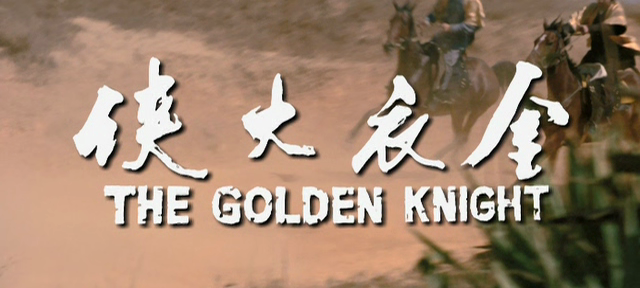
THE GOLDEN KNIGHT (1970) #047

THE GOLDEN KNIGHT (1970)


Producer Runme Shaw gives us THE GOLDEN KNIGHT (1970) a wuxia, suspenseful who-done-it with an complex script by Liang Yen (Yip Yat-Fong) [Black Butterfly 1968)] and [The Jade Raksha (1968)] co-written by Huang Feng (Wong Fung). It released April 17th and was directed by Yueh Feng [Rape of the Sword (1967)] and [The Bells of Death (1968)] with action direction by Han Kuo.  (A word about the title: in Chinese there is no such convention as adding an "s" to indicate plural nouns so the title in English could have been translated: THE GOLDEN KNIGHTS and as such would have been much more accurate considering the events of the movie. )


It is a solemn day for the Jiang Hu. The Supreme Grand Master, having been very ill and recognizing his time on earth is nearing an end, has written manuals of his six martial skills to give to six of the major heads of the martial clans. The Poison Palm, the Zen Finger, the Azura Sword, the Deadly Sabre, the Jingang Palm and the Iron Body manuals are all ready to be given to the grand masters of the six major clans on the appointed day at the appointed hour.  


On the appointed day at the appointed hour however only five of the six grand masters had arrived. Grand Master Yu Yun-Yang of Huang Shan Clan had not yet arrived so the Supreme Grand Master reserved the Poison Palm manual for Grand Master Yu Yun-Yang since it was the Huang Shan Clan's specialty and gave the remaining five manuals to the attending five grand masters and bid them to return to their clans. 


On their way back to their clans the five grand masters ran into Grand Master Yu Yun-Yang on his way to their meeting with the Supreme Grand Master and told him of the Supreme Grand Master's intention. The five grand masters then continued on their way back to their clans and Grand Master Yu continued on to see the Supreme Grand Master. But when Grand Master Yu arrived at the Supreme Grand Master's home he found the Supreme Grand Master and his servant had been murdered. Grand Master Yu immediately called out to the five grand masters to return to the Supreme Grand Master's house. 


Hearing Grand Master Yu's cries, the five grand masters ran back to the Supreme Grand Master's house as quickly as they could. When they arrived back at the Supreme Grand Master's house, they found the Supreme Grand Master and his servant dead and Grand Master Yu's bloodied belonging but not Grand Master Yu's body. The five grand masters assumed that Grand Master Yu had been murdered and carried off and could do nothing else but return to their clans and report their experience to The Tongxin Clan, Golden Knights, the clan of justice in the Jiang Hu. 


The Tongxin Clan Golden Knights are the court of justice for the Jiang Hu and all matters of law are brought before them. Shortly after the murder and disappearance of the Supreme Grand Master and Grand Master Yu, the Iron Body Manual was stolen from the Huashan Clan and the Deadly Sabre manual was stolen from the Kongdong Clan with members of both clans being killed in the process. There were two attempts made on the Zen Finger manual at Shaolin Temple but they were both unsuccessful, no one was killed and the manual was not stolen. Circumstantial evidence points to the daughter of the missing, Grand Master Yu Yun-Yang, Yu Fei-Xia --but did she commit these crimes of murder and theft, or did someone else? 


CAST REPORT
the good: Lily Ho Li-Li as Yu Fei-Xia / Jiang Yi-Ming. Kao Yuen as Lu Yi-Nan, a Golden Knight. Wang Hsieh as Master Jing Zheng-Lun, a Golden Knight.  Fan Mei-Sheng as Guan Xi-Yang, a Golden Knight. Wong Ching-Ho as Shaolin Abbot Yi-Shu. Ku Feng as Monk Tieh Teng, a Golden Knight.  Chuen Yuen as Chief of Tongxin Clan Golden Knights. 
the bad: Yeung Yip-Wang as Master Bao. Shu Pei-Pei as Ai Qing. Hsu Yu as the Censor's wife. Lan Wei-Lieh as a fake Imperial Guard.


HONORABLE MENTION: Cheng Miu and Sammo Hung Kam-Bo guest star in small roles.


FIGHT TIME: THE GOLDEN KNIGHT (1970) credits Han Kuo with the action direction of the movie but director (Griffin) Yueh Feng has too much of a heavy hand with his hand held shaky cam that readers of my past reviews know I am not a fan of. There were only six (6) fight scenes in the entire movie and they were not too bad for what I could see of them but the constant movement of the camera really robbed me of a clear view in many of those scenes and it was very annoying. That said, Han Kuo kept the movie's pace fast and exciting and I hardly noticed that there could have been another fight or two just for good measure. An acceptable performance. 


THE GOLDEN KNIGHT (1970) is a movie that, as I think about it, is probably easier to experience by Mandarin Chinese speakers than by English subtitle readers. The double flash-back one third in the movie that is actually the movie's beginning along with the lack of detail in the subtitles about just who The Golden Knights were leaves one playing catch-up quite a bit on the first viewing. If that wasn't challenging enough if the viewer has no knowledge of the Jiang Hu then the viewer really needs to watch the movie a second time before it feels like a smooth story-telling.   


If the viewer does bother to view the movie a second time and think along the lines of an episode of Law And Order Criminal Intent then they have a much better chance to discover the well crafted (but hard to translate) "who done it" scripted by Yip Yat-Fong and Wong Fung. This is one of those movies I believe would do well as a modern remake with jacked-up martial arts scenes. As it is, I can still in good conscious recommend it for ones casual viewing pleasure but as a collectible, maybe not so much. See you next time! 


If you liked this review please comment on the blog, become a follower of the blog, join me on my Facebook account by sending me a message first and then a friend request so I know who I am friending (  https://www.facebook.com/Michael529P   ) and like my Facebook page: SHAW Brothers Kung Fu Movies 1965-1986. I thank you and would appreciate it very much!


NEXT UP: HEADS FOR SALE (1970)


Saturday, March 26, 2016

THE TWELVE GOLD MEDALLIONS (1970)

THE TWELVE GOLD MEDALLIONS (1970)


Our first film of seventies is THE TWELVE GOLD MEDALLIONS (1970), released January 7th, and produced by Sir Run Run Shaw. It is a historical-drama, pursuit / wuxia film based on a story by I Kuang and Chen Tien-I. This all-star cast film is also Chin Ping's farewell film being the last film she was featured in. Scripted and directed by Cheng Kang, the action directing credits are Simon Chui Yee-Ang ( as Hsu Erh Niu) and Sammo Hung Kam-Bo (as Chu Yuan Ling). Let's get busy!


At the root of this film's plot is the history of General Yue Fei : In short, during the Song Dynasty in 1126 A.D., North China was over run by the nomadic Juchen (Jin) and the Song Capital at Kaifeng was taken. General Yue Fei assumed command of the Song forces and after first retreating south he took the offensive and although being greatly outnumbered he forced the Jin to retreat thereby recovering some of the Song's lost territory.  


Unfortunately, one Minister Qin Hui formed a peace coalition and influenced the Song Emperor to negotiate peace with the Jin and call General Yue Fei back from his military campaign, halting his progress. Not knowing the precise location of General Yue Fei, Minister Qin Hui sent out the twelve gold medallions with the emperor's seal on it ordering the general to return. Defying the imperial edit was a capital offense. Knowing the loyalty of General Yue Fei some martial patriots attempted to keep the general from receiving the order in the first place. This was also a capital offense but as true patriots they risked their lives to do it.   


Master Miao Lung was one such patriot. A former apprentice of Grand Master Jin Yan Tang, Chief of the Hua Shan Clan. Master Miao had learned the Wavering Sword technique from Grand Master Jin. Master Miao gained the attention of Minister Qin Hui by defeating Grand Master Ma Shan Ting's top disciple: Lei Ting,  known as the Golden Whip and preventing Lei Ting from delivering his medallion to General Yue Fei. Grand Master Ma Shan Ting (who himself was known as the Golden Fan), summoned Grand Master Jin to his headquarters at Juxian Hall to answer for Master Miao Lung's actions. 


Grand Master Jin Yan Tang arrives at Juxian Hall and ridicules Grand Master Ma Shan Ting for not being worthy of the Emperor's gold plaque and the gold medallion assignment. Grand Master Ma challenges Grand Master Jin and is defeated and killed. However Minister Qin Hui was watching the entire proceedings and is impressed by Grand Master Jin's skill and confidence. Minister Qin immediately promotes Grand Master Jin to the new Chief of Juxian Hall and puts him in charge of delivering the gold medallions to General Yue Fei. 


But Master Miao Lung has also been watching, albeit as a spy on the rooftop. He is discovered by Grand Master Jin but not captured. Master Miao waits for his former teacher by the road that leads to Grand Master Jin's home to confront him. In addition, Grand Master Jin has two daughters whom he must inform of his newly assigned tasks but has little concern how they will react to it. And so begins this heart-wrenching tale of trust, loyalty and  filial piety.


CAST REPORT
THE TWELVE GOLD MEDALLIONS (1970) certainly has an all-star cast: 
the good: Yueh Hua as Master Miao Lung, the hero of the story, Chin Ping as Jin Suo, youngest daughter of Grand Master Jin Yan Tang in her last major performance and as can be expected she is at her very best!   We also have Lisa Chiao Chiao as Jin Huan, elder daughter of Grand Master Jin Yan Tang, and Ku Wen-Chung as Grand Master Green Bamboo Cane Meng Dabei,

the bad: Cheng Miu as Grand Master Jin Yan Tang is the movie's big bad guy, Huang Chung-Hsin as Master Golden Whip Lei Ting, Wang Hsieh as Grand Master Golden Fan Ma Shan Ting, and 
Ku Feng as Ah gui 

HONORABLE MENTION: Fan Mei-Sheng, Lee Kwan, Wang Chung, and James Tien all have small roles as villains.


FIGHT TIME: THE TWELVE GOLD MEDALLIONS (1970) has two fight choreographers and 13 fights (including 3 fights in the grand finale). Simon Chui Yee-Ang and the great Sammo Hung Kam-Bo are the fight choreographers of record ...but still... -- the way I am going to put it is this: either the film editor and or the director obscures the technical aspects of the battles until they are non existent. In this way; it is a disappointment. Put another way: there is plenty of action, plenty of swordplay but no martial arts in this movie. So the question becomes: is it fair of me to expect more in terms of martial arts display in a movie made in 1970? Unfortunately, the answer is yes.  


THE TWELVE GOLD MEDALLIONS (1970) is a very important film especially for those that would be students of this genre or of Hong Kong movies in general. History and pop culture have always played heavily in the plots of many of these movies and sometimes without the basic knowledge of the source material it can burden one's enjoyment of the project. I hope I can add some information and encourage others to view and ultimately enjoy these movies as much as I do. So, if you are serious about watching Shaw Brothers or Hong Kong films or if you are a Chin Ping fan then this is a must have; if not you can pass on it. See you next time!


If you liked this review please comment on the blog, become a follower of the blog, join me on my Facebook account by sending me a message first and then a friend request so I know who I am friending (  https://www.facebook.com/Michael529P   ) and like my Facebook page: SHAW Brothers Kung Fu Movies 1965-1986. I thank you and would appreciate it very much!


UP NEXT: THE WANDERING SWORDSMAN (1970)


Saturday, January 30, 2016

DRAGON SWAMP (1969)

DRAGON SWAMP (1969)


DRAGON SWAMP (1969) is Runme Shaw's production of a fascinating fantasy / wuxia tale from the fertile mind of director and script writer Lo Wei. Using the captivating canvass of the Shaw Brothers beauty Cheng Pei Pei, Lo Wei and make-up artist Fong Yuen add a wonderful dimension to what otherwise had been another "they stole my magic sword" wuxia tale. Let's take a look. 


The JADE DRAGON SWORD is a coveted treasured sword from the Shangzhou Dynasty. Unfortunately, after being used to murder an enlightened personage that was a reincarnation of the holy Buddha it became cursed. Whoever attempts to own the sword is possessed with a madness and their family is fated to be broken. The sword came to be trusted to the Taoist Lingshan Chunyang Monastery. 


Under the current abbot, Master Fan Chung Yun, the Jade Dragon Sword was stolen by Tang Dachuan the White-Faced General. Tang Dachuan seduced Master Fan's student Fan Ying, a 17-year-old impressionable young girl who betrayed everyone and everything she knew for the "love and kindness" of the sweet-talking devil. Three years and two children later (not to mention a certain Jade Dragon Sword) the two lovers hiding place is discovered by Master Fan. Tang Dachuan escapes with the older child and leaves behind Fan Ying and the younger child. Master Fan recovers the Jade Dragon Sword and punishes Fan Ying to a twenty year banishment in the Dragon Swamp but he takes the youngest child with him to raise in his monastery.  


20 years later, a grown up Qing Erh practices the 8 diagram steps at the Jingang Pagoda unaware that she is being observed but when it is discovered that the Jade Dragon Sword has once again been stolen Qing Erh suspects that she is the one responsible for the thief's ability to walk the correct steps to get the sword. She sneaks out of the monastery determined to reclaim the sword for her teacher and ask for his forgiveness. It is not the sword, however, but her face that sets up the incidents that become a fascinating adventure for the young girl and for us. 


DRAGON SWAMP (1969) has an all-star cast but Cheng Pei Pei owns this movie with a duel performance as Fan Ying and her daughter Qing Erh. I have no idea why this movie is not every bit the classic as Come Drink With Me (1966). She nails both roles very convincingly. Director and scriptwriter Lo Wei plays the big good Master Fan Chung Yu and Huang Chung-Hsin plays the big bad Tang Dachuan the white-faced general. Yueh Hua is Roaming Knight Xi Zheng Yuan and Lo Lieh is Head of Security Yu Chiang.
HONORABLE MENTION: Sammo Hung Kam-Bo rises from extra to bit part as "gambler at Chiang's party". 


FIGHT TIME: Sorry, but I found no one credited with the action direction for this film. Although both Lee Siu-Pang and Han Ying-Chieh, (both capable action directors at the time), are in this film neither one is credited anywhere as action directors for this movie. That said, I counted are six (6) full fight scenes and I have learned that that's plenty of action for this time period. The scenes are also pretty well done but I have notice the debut of the concentric circles clock-counter-clock stuntman-go-round that the extras do while waiting for their turn to die in fight scenes and I can't help but smile.

HONORABLE MENTION: As I mentioned before, Sammo Hung Kam-Bo rises from stuntman extra to bit part as "gambler at Chiang's party".  


As I said before,  I have no idea why this movie is not more well known. As famous as Cheng Pei Pei is, DRAGON SWAMP (1969) is a tour de force of Cheng Pei Pei's acting skills as we see her in her 20's 40's and looking like she is in her 60's.   Fong Yuen absolutely deserves another mention as the make-up artist and Lo Wei has indeed whipped up another fascinating story but it is Cheng Pei Pei's acting skills that sell her characters in all their different stages. Bravo to Cheng Pei Pei for giving the Shaw Brothers another classic film that is also epic. Yes, by all means, see it, buy it, borrow it but sorry, no stealing. 


When people summarily dismiss martial art movies from the 1960's, I understand. The level of personal skills that Bruce Lee brought to the movie world raised the bar for every single movie industry in existence. Yet, if you discard our history like that, what of movies like this? We are not better off for not having seen this movie. I am glad however to witness a movement to not only own these classics but to watch them as well. I am also humbled to be able to do my part by blogging these reviews. Good or bad, like or not, let's keep watching. See you next time. 


If you liked this review please comment on the blog, become a follower of the blog, join me on my Facebook account by sending me a message first and then a friend request so I know who I am friending (  https://www.facebook.com/Michael529P   ) and like my Facebook page: SHAW Brothers Kung Fu Movies 1965-1986. I thank you and would appreciate it very much!


NEXT UP: THE FLYING DAGGER (1969)