Showing posts with label YUEH FENG. Show all posts

Saturday, April 30, 2016

THE GOLDEN KNIGHT (1970) #047

THE GOLDEN KNIGHT (1970)


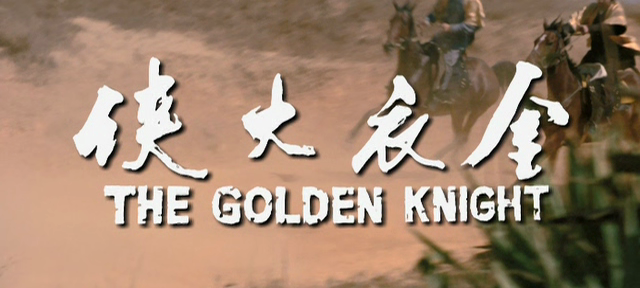


Producer Runme Shaw gives us THE GOLDEN KNIGHT (1970) a wuxia, suspenseful who-done-it with an complex script by Liang Yen (Yip Yat-Fong) [Black Butterfly 1968)] and [The Jade Raksha (1968)] co-written by Huang Feng (Wong Fung). It released April 17th and was directed by Yueh Feng [Rape of the Sword (1967)] and [The Bells of Death (1968)] with action direction by Han Kuo.  (A word about the title: in Chinese there is no such convention as adding an "s" to indicate plural nouns so the title in English could have been translated: THE GOLDEN KNIGHTS and as such would have been much more accurate considering the events of the movie. )


It is a solemn day for the Jiang Hu. The Supreme Grand Master, having been very ill and recognizing his time on earth is nearing an end, has written manuals of his six martial skills to give to six of the major heads of the martial clans. The Poison Palm, the Zen Finger, the Azura Sword, the Deadly Sabre, the Jingang Palm and the Iron Body manuals are all ready to be given to the grand masters of the six major clans on the appointed day at the appointed hour.  


On the appointed day at the appointed hour however only five of the six grand masters had arrived. Grand Master Yu Yun-Yang of Huang Shan Clan had not yet arrived so the Supreme Grand Master reserved the Poison Palm manual for Grand Master Yu Yun-Yang since it was the Huang Shan Clan's specialty and gave the remaining five manuals to the attending five grand masters and bid them to return to their clans. 


On their way back to their clans the five grand masters ran into Grand Master Yu Yun-Yang on his way to their meeting with the Supreme Grand Master and told him of the Supreme Grand Master's intention. The five grand masters then continued on their way back to their clans and Grand Master Yu continued on to see the Supreme Grand Master. But when Grand Master Yu arrived at the Supreme Grand Master's home he found the Supreme Grand Master and his servant had been murdered. Grand Master Yu immediately called out to the five grand masters to return to the Supreme Grand Master's house. 


Hearing Grand Master Yu's cries, the five grand masters ran back to the Supreme Grand Master's house as quickly as they could. When they arrived back at the Supreme Grand Master's house, they found the Supreme Grand Master and his servant dead and Grand Master Yu's bloodied belonging but not Grand Master Yu's body. The five grand masters assumed that Grand Master Yu had been murdered and carried off and could do nothing else but return to their clans and report their experience to The Tongxin Clan, Golden Knights, the clan of justice in the Jiang Hu. 


The Tongxin Clan Golden Knights are the court of justice for the Jiang Hu and all matters of law are brought before them. Shortly after the murder and disappearance of the Supreme Grand Master and Grand Master Yu, the Iron Body Manual was stolen from the Huashan Clan and the Deadly Sabre manual was stolen from the Kongdong Clan with members of both clans being killed in the process. There were two attempts made on the Zen Finger manual at Shaolin Temple but they were both unsuccessful, no one was killed and the manual was not stolen. Circumstantial evidence points to the daughter of the missing, Grand Master Yu Yun-Yang, Yu Fei-Xia --but did she commit these crimes of murder and theft, or did someone else? 


CAST REPORT
the good: Lily Ho Li-Li as Yu Fei-Xia / Jiang Yi-Ming. Kao Yuen as Lu Yi-Nan, a Golden Knight. Wang Hsieh as Master Jing Zheng-Lun, a Golden Knight.  Fan Mei-Sheng as Guan Xi-Yang, a Golden Knight. Wong Ching-Ho as Shaolin Abbot Yi-Shu. Ku Feng as Monk Tieh Teng, a Golden Knight.  Chuen Yuen as Chief of Tongxin Clan Golden Knights. 
the bad: Yeung Yip-Wang as Master Bao. Shu Pei-Pei as Ai Qing. Hsu Yu as the Censor's wife. Lan Wei-Lieh as a fake Imperial Guard.


HONORABLE MENTION: Cheng Miu and Sammo Hung Kam-Bo guest star in small roles.


FIGHT TIME: THE GOLDEN KNIGHT (1970) credits Han Kuo with the action direction of the movie but director (Griffin) Yueh Feng has too much of a heavy hand with his hand held shaky cam that readers of my past reviews know I am not a fan of. There were only six (6) fight scenes in the entire movie and they were not too bad for what I could see of them but the constant movement of the camera really robbed me of a clear view in many of those scenes and it was very annoying. That said, Han Kuo kept the movie's pace fast and exciting and I hardly noticed that there could have been another fight or two just for good measure. An acceptable performance. 


THE GOLDEN KNIGHT (1970) is a movie that, as I think about it, is probably easier to experience by Mandarin Chinese speakers than by English subtitle readers. The double flash-back one third in the movie that is actually the movie's beginning along with the lack of detail in the subtitles about just who The Golden Knights were leaves one playing catch-up quite a bit on the first viewing. If that wasn't challenging enough if the viewer has no knowledge of the Jiang Hu then the viewer really needs to watch the movie a second time before it feels like a smooth story-telling.   


If the viewer does bother to view the movie a second time and think along the lines of an episode of Law And Order Criminal Intent then they have a much better chance to discover the well crafted (but hard to translate) "who done it" scripted by Yip Yat-Fong and Wong Fung. This is one of those movies I believe would do well as a modern remake with jacked-up martial arts scenes. As it is, I can still in good conscious recommend it for ones casual viewing pleasure but as a collectible, maybe not so much. See you next time! 


If you liked this review please comment on the blog, become a follower of the blog, join me on my Facebook account by sending me a message first and then a friend request so I know who I am friending (  https://www.facebook.com/Michael529P   ) and like my Facebook page: SHAW Brothers Kung Fu Movies 1965-1986. I thank you and would appreciate it very much!


NEXT UP: HEADS FOR SALE (1970)


Saturday, November 21, 2015

THE BELLS OF DEATH (1968)

THE BELLS OF DEATH (1968)


Greetings everyone and welcome back. Sir Run Run Shaw is back at us with a very interesting production and he has brought veteran director Yueh Feng with him. Along with his "shakey cam" Yueh Feng has visualized a wuxia film with a strong slasher/horror flavor to it, adding a tremendous amount of tension to the fight scenes. This unique blend of genres is given a subtle boost by rookie screen writer Chiu Kang-Chien first script that adds small details to some of the events in the movie that surprised at least me and gives the characters a lot more depth than the typical revenge movie. I just want to say right quick that a lot of movie hobbyist miss out on some interesting movies because they eliminate movies en mass because of what year they were released. That is a mistake. Right off the bat this movie has a lot going for it. Let's check out the plot.   


Three ruffians on horseback are on their way to a town called Jiangbei but they lose their way and ask a young man atop a tree for directions. He is kind enough to give them directions but one of the three ruffians goes back to thank him by hurling three arrows at him. Fortunately the arrows are off their mark and he is unharmed. As the ruffians continue on they stop at a river and while they are enjoying the water they spot a young woman who seems to have just finished washing clothes. They frighten her away but they plot to track her down and have their way with her. Sure enough they reach her home and slaughter her mother, father and baby brother. As fate would have it the young man atop of the tree that gave the ruffians their directions to Jiangbei was the young woman's younger brother as well. When the young man reaches home and discovers the slaughter he is overcome with two emotions: grief and the desire for revenge. 


Chang Wei-Fu packs a few belongings and then burns down all that remains of his life in Bei He Village. He takes his mother's bracelet, a wiry circle of silver bells, and strings it around his neck, a reminder of his mission of vengeance, his mother's bracelet become the bells of death. He begins his journey to Jiangbei to hunt down the three murderers of his family, to get revenge. As he journeys to Jiangbei he comes across an elder in a straw hat holding a cane sword surrounded by eight armed men. Observing from a distance he hears the armed men call themselves "The Eight Heroes Of Yanzhou" as they give the old man an ultimatum: "surrender or die"! 


Chang Wei-Fu watches in anticipation of the old man's certain death but instead the elder quickly and skillfully dispatches all eight assailants and calmly walks away totally unscathed. At first stunned by the unexpected events, Wei-Fu quickly recovers and trails the elder for a day and a night, nonstop without food or drink begging the elder to take him as his student. After seeing his determination and hearing his story the elder decides to accept Chang Wei-Fu as his disciple and they stay in the mountains and train for five (5) years. 


When we next see Chang Wei-Fu it is he who is wearing the elder's straw hat and carrying the elder's cane sword evidently not only becoming the elder's student be now being the elder's martial heir. Chang Wei-Fu heads straight into Jiangbei to find the three murderous ruffians and blaow! He is suddenly struck from behind and nearly knocked over. It is a damsel in distress running for her life and her freedom from debt collectors that use young girls to settle money matters. Oh yeah, it gets real interesting from here!


THE BELLS OF DEATH (1968) is perfectly cast for effect and that is what makes this a great film but NOT for its kung fu  but, hold on --there isn't anything wrong with that. Remember it is still only 1968 and the standards for kung fu have yet to be set let alone be established so we can be generous knowing in the future the kung fu standard will be established, but this is very much an excellent film. Chang Yi is Chang Wei-Fu and he acts in a strong and stalwart manner as a young man (not a teen) fulfilling his obligation of honor revenge for his family's murder and his elder sister's kidnapping. It is a solid performance and is perfect in juxtaposition to the maniacal psychotic antics of the three ruffians played by Ku Feng, Tien Shun and Lam Kau with Lam Kau' character being the most stable of the three but whenever any one of them is on screen that there is a sense that anything could happen, bravo. 


However the best supporting actor of this film must go to Chin Ping, yes, that Chin Ping in an non-action role as the totally believable damsel in distress and the character that allows us to invest emotionally in the outcome of the film while keeping the stalwart determination of the hero intact. Perfect casting indeed.
HONORABLE MENTION: I don't know why there is any doubt but Sammo Hung Kam-Bo is clearly in this movie, wearing a head covering but still clearly him so I included a screen shot for proof. 


FIGHT TIME: Hey, welcome to my fight analysis for THE BELLS OF DEATH (1968). There is no one credited with the fight choreography in this movie. I counted five (5) fight scenes and they all come after the first third of the movie is over. The techniques are well done but are done in by the shaky cam that director Yueh Feng seems to be quite fond of, not that he over does it this time. I must just admit that I am not a fan of this technique. Fortunately the horror film aspect of the movie is its greatest attraction and the kung fu is but a wonderfully added plus.


Eerie, creepy, spooky, and scary are just some of the adjectives that come to mind when I think of many of the scenes from THE BELLS OF DEATH (1968). The overall theme of the entire movie of how randomly scary the world can be, even if you are just minding your own business is often used in today's movies aimed at the teen audience. I would put this movie up against any slasher or Halloween themed movie produced at any time and so yes I enthusiastically recommend this movie for all audiences and collectors of Shaw Brothers classics except maybe, when watching it, you might just leave the lights on.  See you next time.


UP NEXT: THAT FIERY GIRL (1968)


Saturday, November 7, 2015

THE MAGNIFICENT SWORDSMAN (1968)

THE MAGNIFICENT SWORDSMAN (1968)


Sir Run Run Shaw produces our next movie: THE MAGNIFICENT SWORDSMAN (1968) directed by both Griffin Yueh Feng and Cheng Kang, with the script written by Ko Jui-Fen. I have read of Sir Run Run Shaw great admiration of Japanese movies and this seems to be his homage to them. A derivative product does not in and of itself make a bad movie but can they pull it off? Let's see.  


Jiang Dan Feng is a wanderer known as The Magnificent Swordsman. As he is traveling he is set upon by a pair of bandits whom he dispatches in very quick fashion. However, one of the bandits gives Jiang Dan Feng a dying request to bring his sword to his sister in the nearby Sha Village. A small village that is under siege by the group of bandits these two would-be killers belonged to. Arriving at the village he is held responsible for killing one of the villagers own because, as it turns out, the owner of the sword was just a consort of the bandits but not yet a "full member", if you will. At odds with both the villagers and the bandits he feels obligated to the young sister who is now alone in the world without her brother and decides he will protect her even at the cost of his own life. 


The casting of Huang Chung-Hsin as the lead hero was interesting as hell and I was not at all thinking in favor of it before I experienced the whole movie than after I saw it all the way through. The ebb and flow of the villagers attitude towards the stranger (mostly ebb) was totally in sync with the character portrayal of Huang Chung-Hsin and it helped me accept the movie as it was. Also great casting was Shu Pei-Pei in juxtaposition to Mr. Huang's character with so little sexual tension (read as none what-so-ever) between them that when the impropriety of their company was mentioned, it came off as ridiculous as we were supposed to think it was, which in turn held us at arm's length from the villagers who were not as upright in their thinking as they thought they were. The casting and acting in THE MAGNIFICENT SWORDSMAN (1968) was not its sore point, on the contrary it was quite good. 
HONORABLE MENTION: Tien Feng, Wei Pin-Ao and Cheng Miu   


FIGHT TIME: Well, with such a title as THE MAGNIFICENT SWORDSMAN (1968) the stakes for there being "magnificent" sword fights were pretty high, unfortunately, it was just not to be. I counted five (5) fight scenes including the finale. This is the bare minimum fight count but I assure you THE MAGNIFICENT SWORDSMAN (1968) is not a boring story. The red herring at the very beginning kept us in suspense long enough for the real plot to be set up. Also while there was no one credited for the fight choreography, when I could actually see the techniques they were not bad at all. In fact, a couple or few of the fight scenes were actually quite slick -- especially in the finale, so let me get to what I feel were the two basic fails of the fight scenes that could have been. 


Number one, the shaky or hand held cam scenes were a total fail. Maybe I am bias but I don't get it. I know it is a motion picture but the picture does not have to move. I am just not into a blurry images. Number two: the film editing of the fight scenes was way off. The swordsman would go into a stroke  our eyes would follow the sword but the camera would swing in a random direction and just end up somewhere other than where logic would have you anticipate the technique going, leaving you wondering what you just missed. There was also one other basic fail but it had nothing to do with the fight scenes so I will not put it here with he fight analysis.


 I mentioned at the beginning of this review that "a derivative product is not necessarily an automatic fail" and now I am going to add the "but". But there must be that *uhh* (imagine James Brown uttering it) that makes you feel good after watching it. Something, usually something different about it, that makes you say to a friend, "hey, you have to go see this movie!" Unfortunately, THE MAGNIFICENT SWORDSMAN (1968) doesn't have that *uhh* to help it stand out from the Japanese movies it is obviously paying homage to. The fault could lie in that it is not a remake of any one Japanese samurai movie but a homage to all of them and (in my opinion) needed an extreme expression so that it could also stand on its own and be appreciated. 


The violence was not violent enough, the good guys were not good enough and yes, the bad guys were not bad enough. If even any one of the three were extreme then that would have done it. Instead the whole place and all of its people just seemed to be down on their luck temporarily, and we have all been there. Oh, well and then, we move on. Even further unfortunately if you miss this movie, then any other Japanese classic samurai movie will do at least as well if not much better and so why watch this one? So, I am not going to recommend this movie except for extreme "completist" (collectors that must have every single item). Sorry, but it just be that way sometimes. Every single Shaw Brothers movie will not end up being a classic. Sad, but true. Let me wish you all a HAPPY NEW YEAR 2016 (year of the monkey) and for now, see you next time!   


NEXT UP:  KILLER DARTS (1968)


Saturday, September 26, 2015

RAPE OF THE SWORD (1967)

RAPE OF THE SWORD (1967)


RAPE OF THE SWORD (1967) is produced by Run Me Shaw,  directed by Yueh Feng and the script writing is credited to Wong Po I. It seems to me to be a take on  Water Margin or Outlaws of the Marsh: a wuxia novel that takes place during the Song Dynasty and is based on the adventures of an outlaw, Song Jiang and his companions that band together and become an outlaw clan. In this world where all men (and women for that matter ) are corrupt and evil, a group of bandits decide they will somehow elude some sense of honor and protect the weak, innocent and the common people from the even more corrupt officials. Once again, this film is "retro-produced" and so looks and feels very similar to the black and white, Peking Opera type movies of the 1950's rather than the Chang Cheh state of the art style of the late 60's. Even the lyrics of the songs are usedto advance the plot and characterization of the actors. So once again I am going to show the movie some love and let that sly.  Also the use of music from a non-Chinese source is well known to us Americans since the Quincy Jones Ironside theme was used for Five Fingers Of Death (1973).  So, let's see what we have.   

behind the scenes photographs I found on the internet


The Qing Shuang Sword of the Han Dynasty called the "Sword of the Universe" and is one of the few "treasured swords" left in the Jiang Hu. A treasured sword is one not only of the greatest quality but also spiritually endowed with the essence of a virtue or principle. The owner of the Qing Shuang Sword, a clan master, has died leaving his students with his desire they remain a "righteous and honorable" clan. One of his senior students (Han) however, is having none of that. He murders his younger classmate who was in possession of the sword and offered it to Ming Prince Wu Yi in exchange for an official position as Chief Instructor of the palace guards. The murdered younger classmate's wife who was also his SENIOR classmate (Geng Liu Niang) goes "undercover" to retrieve the Qing Shuang Sword for the sake of her clan, sifu and revenge for her murdered husband. 


This movie's subplot is the origin of the Jiu Hua Shan Outlaws. Judging by the clothing it takes place during the Ming Dynasty. It tells how a mission to return a treasured sword to its rightful clan formed a union between two clans that evolves into a quest for justice as outlaw bandits and two righteous clans become one for the sake of the common people during a corrupt dynasty. 


Li Lihua as Geng Liu Niang is the star of the show and to her credit does a passable job in a thankless role as a woman that must do a "man's job" but remain undercover as a "woman".  I think, if she had been just a little more sneaky with it, or had more of a dual performance I would have been sold. But as I said it was an okay performance as the strong persona was convincing --the weak persona, not so much. Now, Li Ching on the other hand, just ate up the screen. We last saw her in KNIGHT OF KNIGHTS (1966) where she was already billed as the "Asia Movie Queen" and in this movie, she shows why she earned that title. There is no one in the entire movie with more swagger than she. I think back then they called it "moxie".  Everything she does is in a style out of place in a period movie, so she comes across as Bruce Lee did in THE CHINESE CONNECTION (1972) as someone too hip for the room but here she does it five years earlier than Mr. Lee! 


More than half way through the movie two more heroes show up: Kiu Chong as Lo Yi Hu the leader of a group of bandits and Yeung Chi-Hing as Master Liu of Liu Manor to help face-off with the only true villain of the movie Tang Ti (Tong Dik) as Chief Instructor Han. While Lee Wan Chung as Prince Wu Yi and Chen Hung-Lieh as Lord Lu Tian Xia are cast in a negative light they really do no wrong in this movie. Prince Wu was given the sword in exchange for an official post and Lord Lu was just being hot for the general's daughter. 
FUTURE STAR GAZING: You will recognize the recently late Tien Feng as General Zhong Ki, and Ku FengFan Mei Sheng and Wu Ma have small roles as well. 


FIGHT TIME!: Well, once again there is no action choreographer credited forRAPE OF THE SWORD (1967) but this time it is clear someone did that job for this movie. Especially for Li Ching's fight scenes, including a stunt double for her series of back flips during her challenge of the bandit chief. I counted 8 (eight) fight scenes which is plenty for any movie of less than two hours and, as I said, the fight scenes show some work and are pretty good especially when compared to other movies produced at the time that also have no action choreographer credited. They were entertaining enough for my taste so I certainly approve of the performances. Li Ching's fight performances also stood out matching her modern swagger. 


RAPE OF THE SWORD (1967) was a very ambitious project for Shaw Studios with the potential to be a multi-part series with all-stars casts in every project. Unfortunately this potential never saw the light of day as, after this movie,no sequels were ever filmed that I know of.  Thanks to reader Steven Feldman I have learned that there is, in fact, a sequel to RAPE OF THE SWORD (1967) it is called A TASTE OF COLD STEEL (1970)  and features the same antagonists. So, of course it is the next review. Thanks for the heads up Steve! Even with its few flaws (like its title) it is a very enjoyable movie and I certainly recommend it just for that reason. See you next time! 


UP NEXT:   A TASTE OF COLD STEEL (1970)