Wednesday, February 8, 2017

REVIEW #4:THE KNIGHT OF KNIGHTS (1966)

REVIEW #4: 
THE KNIGHT OF KNIGHTS (1966)


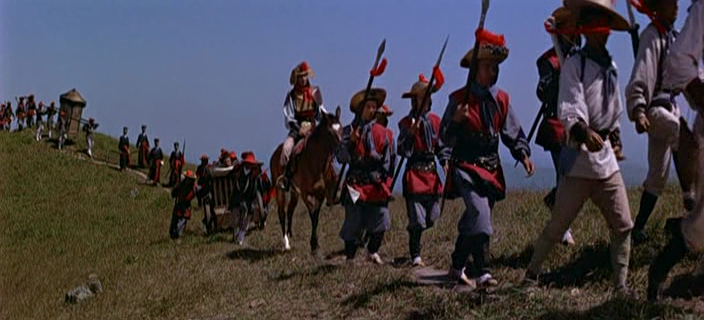
Released May 18th, 1966, THE KNIGHT OF KNIGHTS (1966) is based on a script by Chang Cheh that according to the website Hong Kong Cinemagic is one of Mr. Cheh’s first foray into the wuxia genre. [Chang Cheh was involved in the planning of TEMPLE OF THE RED LOTUS (1965) and THE TWIN SWORDS (1965)]. Produced by both SHAW BROTHERS it is directed by the multitalented Sit Kwan but unfortunately no action director is credited. 


Lee Wan-Chung as Governor Wang
Tang Ti as the bandit Min Kong

During the Ming Dynasty, King Jing of a southern Chinese province entered in an agreement with the Imperial Eunuch Pei to increase the eunuch’s power with the ultimate goal being to usurp the power of the emperor. To this end, King Jing has enlisted the aid of the bandit Min Kong and his men along with the governor of Haimin, Governor Wang. Min Kong and his men disguise themselves as monks and take over the Zhaoqing Monastery as a base of criminal operations. 


Lee Ying as Inspector Lin
The criminal operations of Zhaoqing Monastery consist mainly of human trafficking but it is done as such a level that the people become very disgruntled. To make matters worse, Governor Wang has imposed unfair taxes and has even seized some of the people’s land from them and this causes outrage among the people and attracts the attention of Imperial Inspector Lin who asks his nephew, Wen Suchen of the Seven Men Of Dragon School to investigate the monastery  and the governor and bring him evidence of their crimes.  

Kiu Chong as Wen Sy Chen


Seven Men of Dragon School (minus one)
Unfortunately when Wen Suchen receives the Imperial Inspector’s orders he is visiting his sick mother so he sends his six classmates ahead of him to investigate in his stead. Although his six classmates are highly trained in martial arts they are no match for the booby traps and the hit and run tactics of the fake monks and are wiped out but with one classmate escaping, barely clinging to his life. Wen Suchen and his two young students come across this same classmate on their way to meet up with the rest of the Seven Men Of Dragon School and with his last dying words he tells Wen Suchen of their failed mission at Zhaoqing Monastery!  


Wen Suchen decides a different tact is called for and goes undercover with his two students as a scholar to Zhaoqing Monastery to face Abbot Min Kong. The three of them battle kidnapping, slavery and uncover a plot to murder Imperial Inspector Lin atop of Guanri Pagoda!


CAST REPORT:
the good: Kiu Chong as Wen Su Chen. Lee Ying as Imperial Inspector Lin. Cliff Lok as Wen Lung. Chow Lung-Cheung as Wen Hu. Lily Ho Li-Li as Lin Hong Yu. Lily Li Li-Li as Hsin Yang. 
the bad: Lee Wan-Chung as Governor Wang. Tang Ti as Abbot Kung Ming. Fung Ngai : senior monk. Fan Mei-sheng : senior monk. Tien Shun : senior monk.


Lily Ho Li-Li 's "controversial" scene for the time (1966)
HONORABLE MENTION: Wu Ma, Ku Feng, Liu Liang-Hua, Cheng Lui, Chen Hung-Lieh, Chiu Hung, Wang Kuang-Yu, Simon Yuen Siu-Tin

SPOTTED: Li Ching as Chin (Carpenter You’s sister) and Bruce Lee’s childhood friend (Little) Unicorn Chan as one of the fake monks in the opening of the film. 


FIGHT TIME: THE KNIGHT OF KNIGHTS (1966) has no fight director credited and indeed the quality of the fights (or lack thereof) attests to the lack of skill in the execution of the fight scenes. The fights seemed to me to be very poorly done with the real martial artist looking only slightly skilled and the non-martial artists looking like they had somewhere else to go and wanted to be killed quickly. Not using a fight choreographer was a mistake and the movie suffers from it. I counted only five (6) fight scenes including the short assassination attempt on the Imperial Inspector –enough for a legit kung fu movie and wisely spaced out to keep boredom from being a factor.


HONORABLE MENTION: It is a long way into the movie but, young Cliff Lok has the best-choreographed fight in the movie and is very convincing in warding off multiple opponents. Kudos


RECOMMENDATION: THE KNIGHT OF KNIGHTS (1966) is not a bad movie per-se. It features an all-star cast and guest stars the crème de la crème of the Shaw Brother studios. The script by Chang Cheh is above average as well. It’s major failing is in the lack of martial art style or weapon focus or of martial art choreography. However because of the full back nude scene it is an asterisk in wuxia film history and so it is collectible and should be purchased for this reason. Feel free to keep it in its sealed packaging so it is worth more money. See you next time!


If you liked this review please comment on the blog, become a follower of the blog, join me on my Facebook account by sending me a message first and then a friend request so I know who I am friending (  https://www.facebook.com/Michael529P   ) and like my Facebook page: SHAW Brothers Kung Fu Movies 1965-1986. I thank you and would appreciate it very much!


NEXT UP: THE MAGNIFICENT TRIO (1966)


Wednesday, January 11, 2017

REVIEW #003: COME DRINK WITH ME (1966)

REVIEW #003: 
COME DRINK WITH ME (1966)


October 1965 saw the first release of Shaw Brothers’ new genre of movies "wuxia" : TEMPLE OF THE RED LOTUS and in December of the same year a sequel followed: THE TWIN SWORDS. It would not be until the spring of 1966 that Sir Run Run Shaw would produce the next Shaw Brothers’ wuxia movie: COME DRINK WITH ME.


Released on April 7th, 1966, COME DRINK WITH ME is an adaptation of a Beijing Opera called The Drunken Beggar. In fact, the Chinese translation of the actual title of this movie is Da Zui Xia or Big Drunken Hero. It’s director, King Hu Chin-Chuan also co-wrote the screenplay with newcomer Ting Shan-Hsi (who some sources say also co-directed the film). Han Ying-Chieh served as action director and played a small role in the film. This, Shaw Brother’s third wuxia film would become so well known that it is often mistaken as their first. We shall see why the film is a bona fide classic and is so well loved. Let’s get busy!


A highly skilled and well-organized group of bandits have suffered a defeat at the hands of the provincial governor’s troops, who capture the bandit’s leader and sentence him to death. The remaining bandits kidnap the governor’s son with the intent to trade the governor’s son for the return of their leader and write a petition outlining this request along with a deadline of five days. The governor’s military commander, who also happens to be his daughter, intercepts the petition and offers the bandits another option: release her older brother and surrender in exchange for leniency from the governor –or die!


In the midst of this turmoil is a drunken beggar and a Buddhist abbot fighting over the leadership of a clan whose grand master has died. As they each choose opposing sides, this story has just gotten even more interesting, thus a classic is born!  

Yueh Hua as Fan Ta Pei aka Drunken Hero

Yuen Chi-Hing as Abbot Liao Kung
CAST REPORT:
the good: Cheng Pei Pei as Commander Chang aka Golden Swallow. Yueh Hua as Fan Ta Pei aka Drunken Hero (Drunken Cat) 
the bad: Chen Hung-Lieh as Jade-Faced Tiger. Lee Wan-Chung as Smiling Tiger Tsu Kan. Yueng Chi-Hing as Abbot Liao Kung.

 HONORABLE MENTION: Cheng Pei Pei screen presence is absolutely fascinating to behold. A true movie star!

Simon Yuen Siu-Tin
SPOTTED: Simon Yuen Siu-Tin seasoned action director and actor in independent films including Wong Fei Hung films and destined to become best known in the United States as Sam Seed, the Drunken Master.  His career spanned 325 films and 30 years (1949 to 1979) according to Hong Kong Movie Database.

Han Ying-Chieh  ACTION DIRECTOR
FIGHT TIME: All right, time for my favorite part of the movie review: the fights! Han Ying-Chieh is the fight choreographer for COME DRINK WITH ME (1966) and I counted six (6) major fight scenes pretty much evenly distributed throughout the film. However, they are not all created equal. The first fight scene is the raid on the prisoner’s procession where they kidnap the governor’s son. This fight is brutal, cruel and “economically” shows the viciousness of this group of bandits. 

Golden Swallow's "game face"!
Golden Swallow has three major fight scenes and they are masterpieces of effective double dagger combat against multiple opponents. Drunken Hero Fan Ta Pei has two major fight scenes that work when his martial arts are displayed at the level of master, however when the film tries to depict grand master level skills, the film technology of 1966 just doesn’t do it justice but it is both understandable and forgivable. 


HONORABLE MENTION: Han Ying-Chieh has a small role as a henchman but is the action director of record for COME DRINK WITH ME (1966). However, it seems to me the director King Hu Chin-Chuan gets all the credit for how great the movie is but the fight choreography is always mentioned in the reviews of this undisputed classic. I think it should be a bit more balanced but it is just my opinion. 


RECOMMENDATION: “Mama told me there’d be days like this…” There will be movies such as this that are undisputed classics and as such no recommendations are necessary. Whether you are a collector or casual viewer of films, COME DRINK WITH ME (1966) is a "must see" and "must have". 'Nuff said!


If you liked this review please comment on the blog, become a follower of the blog, join me on my Facebook account by sending me a message first and then a friend request so I know who I am friending (  https://www.facebook.com/Michael529P   ) and like my Facebook page: SHAW Brothers Kung Fu Movies 1965-1986. I thank you and would appreciate it very much!


NEXT UP: KNIGHT OF KNIGHTS (1966)


Saturday, December 24, 2016

REVIEW #002: THE TWIN SWORDS (1965)

REVIEW #002: THE TWIN SWORDS (1965)


Released December 22nd, 1965,  THE TWIN SWORDS (1965) was the sequel and continuation of the story started in TEMPLE OF THE RED LOTUS (1965) an adaptation of the novel, Jiang Hu Qi Xia Chuan (Shang Xia) written by Ping Jiang Bu Xiao Sheng. San Kong repeated his duties as the scriptwriter and Hsu Tseng-Hung returns as director but the elder Shaw brother, Runme Shaw is the producer this time out. Also once again there is no action director or choreographer credited. So, let’s get busy!


We last left our newly wed couple after they were aided in their escape by The Scarlet Maiden from The White Dove Convent (where the evil Red Lotus Clan had their kidnapping and forced prostitution base of operations). The Scarlet Maiden instructed them to “mind their own business” and return to the Gan Family Fortress, practice their kung fu and for Gui Xiao Wu to focus on avenging his parents. Lian Zhu and Xiao Wu headed back to the fortress and had only traveled a short way when they witnessed an apparent kidnapping of four women. It looked very much like the work of The Red Lotus Clan. 


Lian Zhu immediately lunges forward to save the women but Xiao Wu pulls her back. Not only does he want to heed the words of the Scarlet Maiden but he still feels remorse because all that has befallen them has been because of his poor judgment, if only he had minded his own business then they would have never left the Gan Fortress. [See TEMPLE OF THE RED LOTUS(1965) for details] But what husband can resists his wife’s pleadings? Lian Zhu convinces him that rescuing people is not minding someone else’s business and she knows they must be heading to the Red Lotus Temple. So “just this once” they go off to rescue the women. 


But, wouldn’t you know it? It’s a trap and Lian Zhu is captured! Xiao Wu has no choice but to return to the Gan Fortress and face the family that now views him as a traitor and beg them to help him rescue the daughter he caused to be endangered. And as if that weren’t enough, The Red Lotus Temple monks will be prepared for their attack, the danger and risk is obvious yet, how can they not go? Prepared to be rocked by a 1965 state of the art blockbuster!


CAST REPORT
the good: Jimmy Wang Yu as Gui Xiao Wu. Chin Ping as Gan Lian Zhu. Lo Lieh as Du Chuang. Ivy Ling Po as Gui Qiu, The Scarlett Maiden. Petrina Fung Bo Bo as Gan Xiao Ling. Li Ming as Grand Madame Gan. Tien Feng as Master Dragon Gan. 
the bad: Wong Ching-Ho as Red Lotus Chief Fa Ben. Fung Ngai as Red Lotus Chief Hua Fu. Lee Wan-Chung as Red Lotus Chief elder. Special Guest Star: Cheng Miu as Red Lotus Chief Grand Master Chung Yen.

HONORABLE MENTION: Ku Feng, Kao Pao-Shu, Wu Ma, and Lin Jing veteran performers of the Hong Kong movie industry with over one hundred films each!


SPOTTED: Bruce Lee’s childhood friend “Little Unicorn” as a Red Lotus monk. 


FIGHT TIME: Just as in Temple of The Red Lotus, THE TWIN SWORDS has no fight choreographer credited. I counted eight fight scenes once you allow for the first four and a half minutes of THE TWIN SWORDS, which is actually the last four and a half minutes of Temple of The Red Lotus. This is nearly twice the amount of action as the previous movie! The quality of the fight scenes are upheld in the sequel with the techniques displayed being realistic and to the point with no flailing about of the arms and weapons to simulate action. (The sole departing from realistic martial arts comes when the two grand masters go at it head to head in the finale. My instinct tells me to not make too much of this because the creators are in totally uncharted territory here and still managed to express their ideas.  So I decided to give it a pass. )


Chin Ping as Gan Lian Zhu "Warrior Princess"
HONORABLE MENTION: Chin Ping has a solo performance against the entire Red Lotus gang and puts her heart and soul into it! Unlike the first movie, I could not spot a single substitution of a stunt double during this entire fight and I even caught a moment when her sword bent from her putting all her strength into her techniques! Bravo! 


Bent sword at 16:54  but quickly edited out, great performance!

RECOMMENDATION: THE TWIN SWORDS (1965) is only the second movie in our journey of the early Shaw Brothers wuxia classics and the standard is already very high. This two-part adaptation of Jiang Hu Qi Xia Chuan (Shang Xia) [TEMPLE OF THE RED LOTUS being the first part] is fantastic and I can easily recommend this classic for collectors and casual viewers of martial art movies alike. The story and the action both hold up even fifty years later, see you next time!


If you liked this review please comment on the blog, become a follower of the blog, join me on my Facebook account by sending me a message first and then a friend request so I know who I am friending (  https://www.facebook.com/Michael529P   ) and like my Facebook page: SHAW Brothers Kung Fu Movies 1965-1986. I thank you and would appreciate it very much!


NEXT UP: COME DRINK WITH ME (1966)


Sunday, November 27, 2016

REVIEW #001: TEMPLE OF THE RED LOTUS (1965)

REVIEW #001: TEMPLE OF THE RED LOTUS (1965)


Released on October 1st, 1965, TEMPLE OF THE RED LOTUS (1965) was produced by Sir Run Run Shaw and was the first movie that showcased wuxia themes and action without being encased in Chinese Opera. The script was written by San Kong based on a series of wuxia stories written by Ping Jiang Bu Xiao Sheng called Jiang Hu Qi Xia Chuan (Shang Xia). Unfortunately not much else is available on the author or his series in English. The movie adaptation was directed by Hsu Tseng-Hung, a long time cinematographer, TEMPLE OF THE RED LOTUS (1965) was the first time Mr. Hsu directed a movie! There is no action director or choreographer credited for this movie. Let’s get busy!

JIMMY WANG YU as Gui Xiao Wu

Central to the story of TEMPLE OF THE RED LOTUS (1965) is the Jin (Gan) family Castle located in Dragon Valley and the “knights” of Jin Family that are known for bringing justice to others in the Jiang Hu even if it means challenging other martial artists. A young warrior (Gui Xiao Wu) with a military background has been betrothed to the Jin family and on his way to reunite with his bride-to-be stumbles upon an escort caravan being attacked by masked armed warriors. 


Gui Xiao Wu decides to get involved and defend the escort caravan. He is injured and knocked unconscious for his trouble by the masked attackers. When he wakes up, he discovers the great swordswoman; the Scarlet Maiden has treated his wound and they become acquainted. 


The Scarlet Maid seems very concerned with Gui Xiao Wu and advises him to stay focused on training to revenge his parents and go to Jin Castle to improve his kung fu. She tells him how to get to Dragon Valley and Jin Castle and sends him on his way. After Gui Xiao Wu gets to Jin Castle, in the middle of the night, the monks of the Temple of the Red Lotus attack Jin Castle.  After the battle, Gui Xiao Wu believes he knows the identity of the masked robbers, --the very family he is to be wed into! What is he going to do, now?!

IVY LING PO as The Scarlet Maiden

CAST REPORT: Sir Run Run Shaw assembled an all-star cast of some of the greatest actors Shaw Brother Studios had to offer!

the good: Introducing: Jimmy Wang Yu as Gui Xiao Wu. Introducing: Lo Lieh as Du Zhuang. Chin Ping as Jin Lian Zhu. Guest starring Ivy Ling Po as The Scarlet Maiden. Li Ming as Great-grand Madame Jin. Tien Feng as Master Dragon Jin. Lin Jing as Madame Jin (Lian Zhu’s mom). Petrina Fung Bo Bo as Jin Xiao Ling. 

Petrina Fung bo Bo as Jin Xiao Ling
The bad: Introducing: Chow Lung-Cheung as Monk Zhi Bao. Fung Ngai as Red Lotus Chief Fa Fu. Wong Ching-Ho as Red Lotus Chief Yan Zong. Lee Wam-Chung as Red Lotus Chief Zhang Yuan. Chen Hung-Lieh as Monk Zhi Yuan. Wu Ma as Monk Zhi Lai. 

SPOTTED!: Tang Chia, Liu Chia-Liang, and Yuen Wo-Ping are listed by Hong Kong Movie Database as cast members in the movie as Red Lotus members. While I did spot Tang Chia and Liu Chia-Liang, I was unable to spot Yuen Wo-Ping.  


Tang Chia

Liu Chia-Liang corner left
FIGHT TIME: TEMPLE OF THE RED LOTUS (1965) has no action director credited. I counted five (5) fight scenes including the big finale at The White Dove Convent. There is almost no empty-handed combat. All combatants excel in throwing projectiles but it is particularly a specialty of the Jin Family. The fights at Jin Castle are the main battles of the movie. The Yuan-Yang Sword technique is a featured sword style that is very powerful but the young couple has yet to master it. 


Now, let's talk about the kung fu, because, let's face it, it is why I started watching these movies and got hooked on Shaw Brothers in the first place. I remember in the 1980's when wushu in America first became a big thing and there was a lot of discussion on what was the difference was between "kung fu" and "wushu" techniques. Well, as I am currently watching "The Journey of Flower" a Chinese drama from Chinese television on Youtube, the answer would be to watch any pair of fights one from " The Journey of Flower" and one from "Temple of The Red Lotus" and it would be obvious as to what the difference was, although to express it in words still might prove challenging. The words that came to mind as I watch the fights in Temple of The Red Lotus were "raw" and "realistic". The techniques displayed in Temple of The Red Lotus were also "to the point" and very practical. I really appreciated that even though I also like the fancy stuff as well. There is very little flailing and waving arms and weapons about pointlessly. The martial arts here are definitely worth looking at and every so once in a while someone throws in a nice stance. As far as the amount of action, I am going to say that five fight scenes is a fair amount of action and will use five battles as the standard by which to judge the amount of action in future movies. 


HONORABLE MENTION: Jimmy Wang Yu shows off his athleticism and seems skilled in martial arts. (Lo Lieh, not so much.) Chin Ping also does a good job when performing her stunts although she is still occasionally stunt doubled. The casting here is very balanced between male and female.

a technique from the Yuan Yang Sword Style

The Scarlet Maiden watches over them
RECOMMENDATION: TEMPLE OF THE RED LOTUS (1965) is a great adaptation than makes me want to read the novel and learn more about The Scarlet Maiden and her previous adventures. But, as I said earlier, the novels are not available in English. These are all interesting characters and in addition to being a historical collector’s item, I recommend this movie because the story and action are worth-while, for any viewers of martial arts movies. I honestly did not think I would enjoy this movie because of its age. If the rest of the movies are this good then I can be very excited about all the work ahead of me. See you next time!


If you liked this review please comment on the blog, become a follower of the blog, join me on my Facebook account by sending me a message first and then a friend request so I know who I am friending (  https://www.facebook.com/Michael529P   ) and like my Facebook page: SHAW Brothers Kung Fu Movies 1965-1986. I thank you and would appreciate it very much!


NEXT UP: THE TWIN SWORDS (1965)