Showing posts with label LIU CHIA-LIANG. Show all posts

Tuesday, May 16, 2017

Review #7: THE TRAIL OF THE BROKEN BLADE (1967)

Review #7: THE TRAIL OF THE BROKEN BLADE (1967)


Released March 4, 1967, THE TRAIL OF THE BROKEN BLADE was produced by Sir Run Run Shaw. The prolific Chang Cheh directed, scripted and wrote the lyrics to the songs. Based on the title, I would say this production was influenced by the popular westerns of the day in the movies and on television. As far as I can tell, this is the first "eastern / western".  The skilled team of Liu Chia-Liang and Tang Chia did the fight choreography. Let’s get busy. 

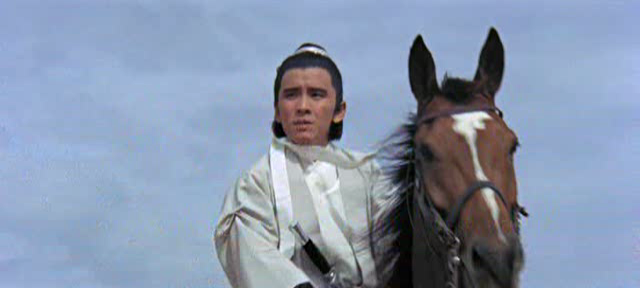
Kiu Chong as Fung Jun Zhao


Planning the caper

The prize!

Fang Jun Zhao is one of the top, up and coming students of Wu Dang Mountain. While on his way back to Wu Dang, he stops at a very small in  Guandong Province for a rest. From the room next door he overhears a planned robbery of the household of retired Commander-in-Chief, Liu Xian. The bandits planning the robbery are persuading the younger son of the Flying Fish Island Clan Chief named Tu Hu, to help them because of the superior martial arts of the Liu family. The head bandit entices Tu Hu, not only with the promise of plenty of money but with a description of Liu Xian’s daughter, Liu Zhen’Er as the village beauty and how he could enjoy her thoroughly as she is “a perfect match for someone as bright as you.”


Later that same night, the bandits attempt the robbery but Fang Junzhao assists Liu Xian and his daughter the end result being all of the bandits dead and Tu Hu severely wounded by Fang’s dart and escaping back to Flying Fish Island. 

After the crisis, Liu Xian asks Fang Junzhao to stay a few days and instruct his daughter in the way of the sword. What Zhen’Er’s father really hopes is that Junzhao and Zhen’Er form a bond and then fall in love so that his daughter can forget her childhood love: Li Yue


Li Yue is the son of the former Commander-In-chief of Zhejiang, the great hero, Li Tian Cong. Tragically; this great hero was falsely convicted and imprisoned all for the benefit of a crooked Imperial Minister. After his father died in prison, Li Yue murdered the Imperial Minister and has been on the run ever since.

When Fang Jun Zhao hears this heartbreaking story from Zhen’ Er's lips his chivalry takes over and he swears a platonic friendship with her and vows to find Li Yue and unite the two lovers to prove his honor and their friendship. 


"I must find Li Yue of Jiangnan"


Meanwhile, Tu Hu has made it back to Flying Fish Island but his injury has taken the ultimate toll as he offers up the fatal dart to answer his family’s question of “who has done this to you?” His father orders his eldest son to take his four henchmen with him to find this Fang Jun Zhao.
So we have the two sets of travelers headed to their destinations fated to meet each other and provide us with this early tale of the Jiang Hu and the chivalry of heroic bloodshed.

Jimmy Wang Yu as Li Yue of  Jiangnan

CAST REPORT
the good: Jimmy Wang Yu as Li Yue / Jiang Qi. Kiu Chong as Fung Jun Zhao. Chin Ping as Liu Chen Erh. Lisa Chiao Chiao as Shi Xiao Mei. Wei Pin-Ao as Shi Gan. Fan Mei-Sheng as Hu Zi.

the bad: Tien Feng as Chief Tu Qian Qiu. Chen Hung-Lieh as Tu Long. Wang Kuang-Yu as Tu Hu, Leopard Skin.

SPOTTED: Liu Chia Liang, Tang Chia, Liu Chia Yung, Wu Ma, Cheng Lui,  Cliff Lok and Pang Pang.

HONORABLE MENTION: According to HKMDB and the release date of THE TRAIL OF THE BROKEN BLADE (1967) this is Yuen Shun Yi’s (of the Yuen Clan) first movie appearance.

Liu Chia-Liang


FIGHT TIME: THE TRAIL OF THE BROKEN BLADE (1967) features the fight choreography of Liu Chia Liang and Tang Chia. I counted 6 (six) fight scenes including its very long finale in the one hour and forty-four minute movie, which to be honest, is not quite as much as in past movies. With the genre being only 7 projects old in the span of two years, I am mindful to not be too harsh in my analysis of the techniques. Using a system of “pass” or “fail” this movie’s fights are definitely a “pass”.


HONORABLE MENTION: Jimmy Wang Yu looks excellent in his fight scenes and director Chang Cheh wisely gives him the majority of the screen time and stunts. 


RECOMMENDATION: THE TRAIL OF THE BROKEN BLADE (1967) has enough characterization, plot and action to entertain you and hold your interest. As the first “eastern / western”, and an early Shaw Brothers classic it is also certainly collectible. Therefore it should come as no surprise that I call for you to take out your cards or cash and pick this one up as a “must have”!  On a personal note I would love to discuss as a film group just what is it that motivates a writer / director to resolve a story in the controversial way that Chang Cheh does in this movie. That’s it for now, see you next time.


If you liked this review please comment on the blog, become a follower of the blog, OR join me on my Facebook account by sending me a message first and then a friend request so I know who I am friending (  https://www.facebook.com/Michael529P   ) and like my Facebook page: SHAW Brothers Kung Fu Movies 1965-1986. I thank you and would appreciate it very much!


NEXT UP: 
THE SWORD AND THE LUTE (1967)


Saturday, March 11, 2017

REVIEW #5: THE MAGNIFICENT TRIO (1966)

REVIEW #5:
 THE MAGNIFICENT TRIO (1966)


Released October 08th, 1966, THE MAGNIFICENT TRIO (1966) reunites the cast and crew of TIGER BOY (1964). TIGER BOY was “an experiment” Sir Run Run Shaw permitted Chang Cheh to engage in to produce a new genre in films provided Mr. Cheh kept expenses low. To that end Mr. Cheh used all new actors in the starring roles, used no martial arts action directors and filmed the movie in black and white. Chang Cheh also wrote and directed the film that was not released until Sir Run Run Shaw was convinced that the new genre was indeed a success. TIGER BOY was given a limited release February 16th, 1966 according to HKMDB (Hong Kong Movie Database).  Elder brother, Runme Shaw produced THE MAGNIFICENT TRIO with the script written once again by the director, Chang Cheh adapted from the Japanese movie: THREE OUTLAW SAMURAI (1964). Tang Chia and Liu Chia Liang were the action directors. Let’s get busy!


"CLICK" to enlarge and read more about TIGER BOY (1964)


THE MAGNIFICENT TRIO (1966) takes place during the twilight of the Ming Dynasty in China as the Han people fight off the Manchu invaders of the north. After a fierce battle the Manchu forces have some Han forces surrounded. Commander Lu Fang, the grandson of the Ming General has escaped the Han troop's encirclement and is on his way to see the Imperial Minister Yuan to request reinforcements when he comes across three villagers kidnapping a young noble woman. 

scene from THE MAGNIFICENT TRIO (1966)

same scene from THREE OUTLAW SAMURAI (1964)
The young noble woman is Wei Wen Zhen, the daughter of the County Magistrate Wei Huaire. The three kidnappers are the Head of Mati Village: Gao Bao-Shi, his son: Gao Ji-Xian and another village dweller: Li Chu-Yen. Commander Lu Fang learns that Mati Village has suffered from several years of drought and the Imperial Court has exempt the village’s provisions from taxation. However, County Magistrate Wei Huaire has continue to tax the village of Mati and otherwise oppress the villagers until, in desperation, they came up with this plan to kidnap his daughter which is to essentially sacrifice their own lives to save their village. 


Back at the Magistrate’s residence, the enraged Magistrate Wei Huaire has become desperate to resolve his daughter’s kidnapping before The Imperial Minister comes for his periodic inspection and reports any irregularities to the Emperor. Prisoners and thugs of all sorts are promised rewards in return for his daughter’s safety but is there ever any honor among thieves?


The star, Jimmy Wang Yu  (right)

CAST REPORT
the good: Jimmy Wang Yu as Commander Lu Fang. Lo Lieh as Yan Ziqing. Cheng Lui as Huang Liang. Margaret Tu Chuan as Li Ju Shan’s wife. Chin Ping as Wei Wen Zhen. Fanny Fan Lai as Xiao Qing. 
the bad: Lui Ming as Magistrate Wei Huaire. Lee Wan-Chung as the Magistrate’s advisor. Tang Ti as Master Xin / Qian. Fung Ngai as Master Han Rui. Ng Ho as Constable Liang Tong.

HONORABLE MENTION: Tien Feng, Ku Feng, Cliff Lok, Chen Hung-Lieh, Chang Pei-Shan, Wu Ma, and Violet Pan Ying-Zi.

SPOTTED: Little Unicorn Chan, Tang Chia and Liu Chia-Liang.

Bruce Lee's childhood friend Little Unicorn, center left.

Liu Chia-Yung (right) as a stuntman

extreme left: Tang Chia, extreme right: Liu Chia-Liang
FIGHT TIME: This is the first credited team-up of what is to become the legendary choreography team of Liu Chia-Liang and Tang Chia.  That fact makes this a collector's item! I counted eight (8) fight scenes and some minor skirmishes for an action-packed one hundred and three minutes. The most common mistake made when watching old movies is to judge them using the current standards instead of the standards of the time in which they were made. That said, everybody’s techniques including the killing techniques were clean, functional and precise for the most part. The exception being, some of the multiple killing techniques that sometimes missed their marks but not so much as to ruin the movie. These gentlemen did a great job and we know there is more to come!


RECOMMENDATION: Unfortunately the first movie ever directed by Chang Cheh: Tiger Boy (1964) is out of print and unavailable so I may never see, let alone review this movie in my lifetime. This review of the second movie ever directed by Chang Cheh, THE MAGNIFICENT TRIO (1966) demonstrates the how skilled Mr. Cheh was at characterization. Since it is an adaptation and not an original script I am not comfortable giving an opinion on his writing skills based on this movie but history speaks volumes about Mr. Cheh’s writing talent so there is no need for me to add my silly two cents on the matter.  I can say that I was thoroughly entertained by all aspects of the film and so I can recommend it wholeheartedly to collectors and casual viewers alike. See you next time!


If you liked this review please comment on the blog, become a follower of the blog, join me on my Facebook account by sending me a message first and then a friend request so I know who I am friending (  https://www.facebook.com/Michael529P   ) and like my Facebook page: SHAW Brothers Kung Fu Movies 1965-1986. I thank you and would appreciate it very much!


NEXT UP: THAT MAN IN CHANG-AN (1967)


Saturday, July 30, 2016

THE NEW ONE-ARMED SWORDSMAN (1971) #60

THE NEW ONE-ARMED SWORDSMAN (1971)


Shaw Brothers Studios' history speaks for itself. It successes in the film industry are legend and it's one of the few movie companies that can get you sick and tired of hearing someone say the word "classic" after hearing the title of a movie produced by that very studio. But still (I always wanted to say that!) they were not perfect in every decision and, so --a lack of belief and insufficient monetary reward caused them to lose one of their biggest stars after 1970. In 1971 Shaw Brothers decided to re-launch one of their biggest hits without its original star


"The king is dead, all hail the king!" Jimmy Wang Yu is gone and producer Runme Shaw has a new sheriff in town and his name is David Chiang in the form of THE NEW ONE-ARMED SWORDSMAN (1971) released February 7th. The brand new script is written by wuxia specialist I Kuang and directed by frequent collaborator Chang Cheh. The action direction is by the team of Liu Chia-Liang and Tang Chia and as in the original also features a brand new weapon. Let's get busy!


Lung Yi  Zhi had long been a hero of the Jiang Hu and a defender of the underdog at least in the public eye. But "Big Hero Lung" as he was known had a dirty little secret (or two or three). Once Lung Yi Zhi had come up a bit in age he became insecure about his reputation as top fighter in the Jiang Hu. Among the young and up-coming fighters were the users of the two-sword fighting technique that seemed quite popular among the other young fighters. Lung Yi Zhi carefully constructed a weapon (a three-sectioned staff) and counter techniques to defeat this new style of swordplay but the problem still remained how to keep his name as top fighter valid and his reputation as defender intact all at the same time. He could hardly start challenging the younger swordsmen without being considered a bully. 


Sadly, he began to fabricate situations  revolving around these young fighters, and then swoop in "to the rescue" and defeat them. Rather than kill his young opponents he would "punish" them by having them chop off their own right arms and swear to retire from the Jiang Hu forever. He would often rob a security escort's cargo and use his men to blame the targeted swordsman. He would then return the cargo after "punishing" the young swordsman even further raising his status as a hero. The punished swordsmen would never speak of the incident to anyone out of their very own shame. Over the years it has added up to quite a number of young swordsmen. Soon it would be the young hero Lei Li's turn. Lei Li used a long saber and a shorter companion knife. However his reputation for his arrogance almost outmatched his reputation for his swords skills. Our story begins as the hero Lei Li falls into Lung Yi Zhi's web of deceit.


CAST REPORT

the good: David Chiang as Lei Li. Ti Lung as Hero Fung. Li Ching as Ba Jiao.

the bad: Ku Feng as Lung Yi Zhi. Chen Sing as Chief Chan Chun Nam.

 HONORABLE MENTION: Wang Chung, Lau Gong, Huang Pei-Chih, Wang Kuang-Yu, Cheng Lui, Bruce Tong Yim-Chaan, Yau Ming, Liu Chia Yung and Cheng Kang-Yeh.


Replacing Jimmy Wang Yu as the new one-armed swordsman is David Chang as Lei Li going with a different type of character for the lead this time. Ti Lung is very much a co-star replacing Lisa Chiao Chiao's character as the influential person in the one-armed swordsman's life. Ti Lung's character is named Fung Jun Jie and is a rash young swordsman also inexperienced as was Lei Li. The two characters immediately relate to one another and the strong chemistry between the two actors makes this an old school bro-mance and communicates the necessary emotions as we move along in the story. Li Ching is Ba Jiao: the love interest and is the only woman in the movie so I guess she serves so we "don't get the wrong idea --not that there's anything wrong with that" as to the hero's preference.  She is also, along with the eatery keeper, responsible for an unintentional laugh when he suggests the ruffians only wanted "to have some harmless fun" with her. Yeah right! 


For the "bad guys" Ku Feng is fantastic as the very complex Lung Yi Zhi the aging hero swordsman who keeps crossing the line to keep his status in the Jiang Hu but always wanting to jump back over to the side of righteous. A slippery slope indeed. Roles such as this usually go to Tien Feng or more veteran actors but Ku Feng was excellent casting as history has shown us. Chen Sing is also a villain of note being the Chief of Tiger Mansion where a lot of the action takes place. 


FIGHT TIME!: Liu Chia Liang and Tang Chia (Tong Gaai) are back as the action choreographers. I counted six (6) full fight scenes not including little short scrimmages, so there is plenty of action but is it me or was there an attempt to tone down the carnage compared to the last version? but having just seen RETURN OF THE ONE-ARMED SWORDSMAN (1969) last week as opposed to seeing them two years apart, the carnage was a bit more vicious and varied in Return Of Then One-Armed Swordsman than in THE NEW ONE-ARMED SWORDSMAN (1971). Well as least to me. However the techniques were a bit more sophisticated in The New One-armed Swordsman, but then, all of the players this time around were much more martially inclined than Mr. Wang Yu, no offence of course. Over all, the techniques and combinations were now much more difficult in their execution and so the action is starting to favor a more knowledgeable fan base as it pertains to martial arts and as history shows, the trend continued. Also of note neither Liu Chia Liang nor Tang Chia made an on-screen appearance. They both usually do at least an cameo in a martial capacity of some sort. I don't know if this means anything, though. 


RECOMMENDATION
Chang Cheh directed and I Kuang (Ni Kuang) was the lone script writer this time around. Over-all after the much much more of "The Return",  "The New" just seems like much much less. But by no means does "much much less " mean bad. By no stretch of the imagination is this a bad movie. Nor have I read any review or heard any fan say anything of the sort. So, what happened? Why no sequel? Why no continuation of the franchise with the new stars?


For my money they should have at least done one more sequel with everything amped up. Alas they did not. Does anybody know why? What ever the reception was of THE NEW ONE-ARMED SWORDSMAN (1971), TRIPLE IRONS (1973) clearly cemented the kung fu craze of the seventies in the United States.Movies theaters started specializing in kung fu double and triple features. We demanded more and we got it. I recommend THE NEW ONE-ARMED SWORDSMAN (1971) without hesitation or reservation. See you next time!


If you liked this review please comment on the blog, become a follower of the blog, join me on my Facebook account by sending me a message first and then a friend request so I know who I am friending (  https://www.facebook.com/Michael529P   ) and like my Facebook page: SHAW Brothers Kung Fu Movies 1965-1986. I thank you and would appreciate it very much!


NEXT UP: MISSION IMPOSSIBLE (1971) 


Saturday, July 9, 2016

THE SINGING KILLER (1970) #057

THE SINGING KILLER (1970)


The Singing Killer (1970) released 12/22 is Shaw Brother's the last kung fu movie released in 1970. Sir Run Run Shaw produces Master Director Chang Cheh's heist / kung fu / modern music / romantic / young people's slice of life in Hong Kong / dramatic movie. This movie is definitely one for the time capsule with everything and the kitchen sink from the Shaw Brothers Studios packed inside it and it takes itself very seriously. The script is co-written by I Kuang and Chiu Kang-Chien, and the song lyrics are written by director Chang Cheh. Action direction is by the skillful team of Tang Chia and Liu Chia Liang so it is a legit kung fu movie. Let's get busy! 

Chen Sing the "Chinese Clark Gable"

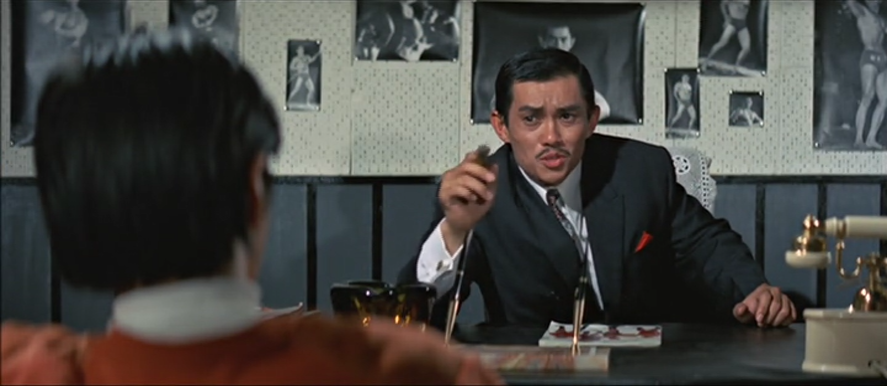
Mr. Fung is a music promoter and the manager of the Dragon Palace Night Club. Mr. Fung is also an independent member of the criminal underworld in Hong Kong. Occasionally his legit world and his illegal underworld would cross paths but this time they will totally collide as his multi-million dollar jewelry heist of Tse's Jewelry Shop is missing one "key" element. That element is someone to crack open the safe in the manager's office. Namely Mr. Fung's heist requires the skills of the Singing Killer himself, the former criminal gang member known as "Johnny".   

David Chaing doing teen angst

Mr. Fung is keenly aware of Johnny's reluctance to return to a life of crime but he also knows Johnny's weakness --"Lily". Lily is the love of Johnny's life and his former gang member and girlfriend. They have long went their separate ways but Johnny would do anything to be reunited with Lily or at least, that's the plan...

Wang Ping as "Shiu Hsien"

CAST REPORT
the good: David Chiang as Johnny. Wang Ping as Shiu Hsien (Lily). Stanley Fung as Detective Wang.
the bad: Chen Sing as Manager Fung. Tina Chin Fei as Ho Man. Ku Feng as Brother One.

HONORABLE MENTION: Ti Lung, Dean Shek, and Wang Chung have very small roles. 

The Crew
FIGHT TIME: THE SINGING KILLER (1970) spared no effort by assigning the masterful team of Tang Chia and Liu Chia-Liang to do their fight choreography which consisted of street-fighting and some gun play. I counted six (6) fight scenes which is not very action-packed but with the drama and music necessary for the story any more action would have made for a much longer film which I can see them not wanting to risk on a multi-genre movie. Bottom line is you can't do too badly with these guys as your action directors, they do good as usual.

HONORABLE MENTION: And the Academy Award goes to...Chen Sing for pretending he can't fight! 

David Chiang versus Wang Chung

Let's dance!

RECOMMENDATION:
I'll have to recommend THE SINGING KILLER (1971) if for no other reason than the off-the-cuff kick-in-the-stomach realism it portrayed in depicting life on the run for young street people in Hong Kong. If you are not used to Hong Kong movie realism then you might be taken aback when one of the female characters has to "pay the rent" for the group. Unfortunately this does not come until the movie is two thirds over and so you might be bored by the goody-goody two step of the early part of the movie. Over-all this is a movie one should "have" rather than "not-have" but I will not call it a must-see movie. It is, however, a unique look at Hong Kong in the 1970's and as such as some collectible value. See you next time!


If you liked this review please comment on the blog, become a follower of the blog, join me on my Facebook account by sending me a message first and then a friend request so I know who I am friending (  https://www.facebook.com/Michael529P   ) and like my Facebook page: SHAW Brothers Kung Fu Movies 1965-1986. I thank you and would appreciate it very much!


NEXT UP: KING EAGLE (1971)